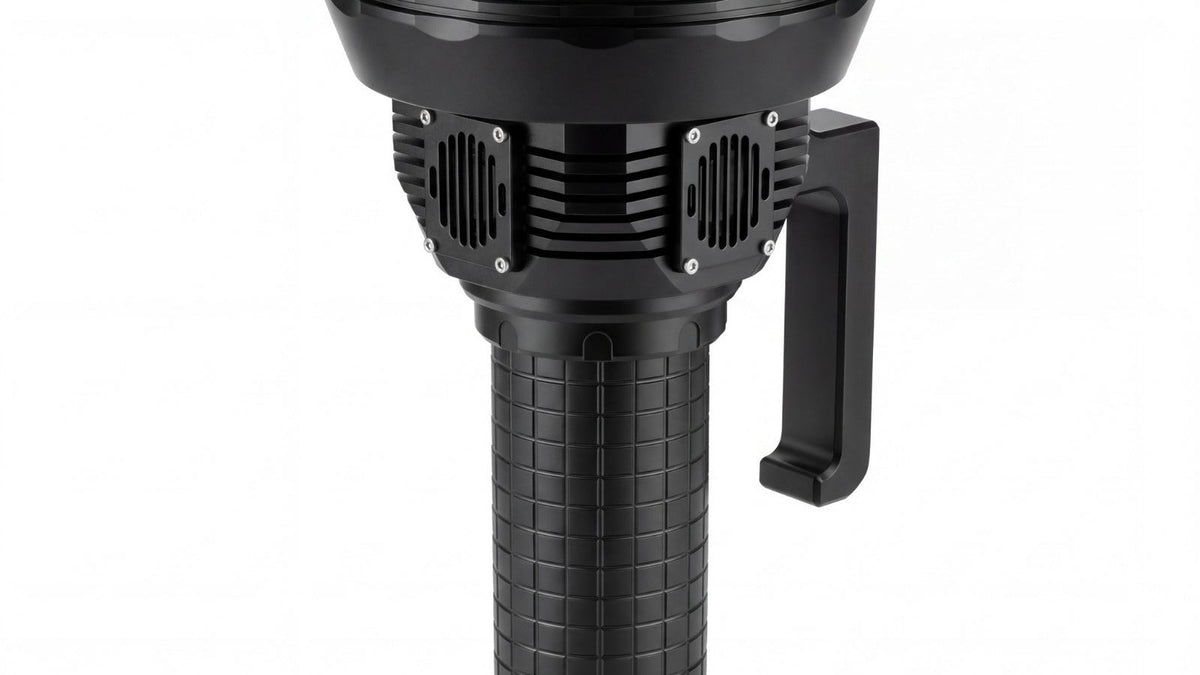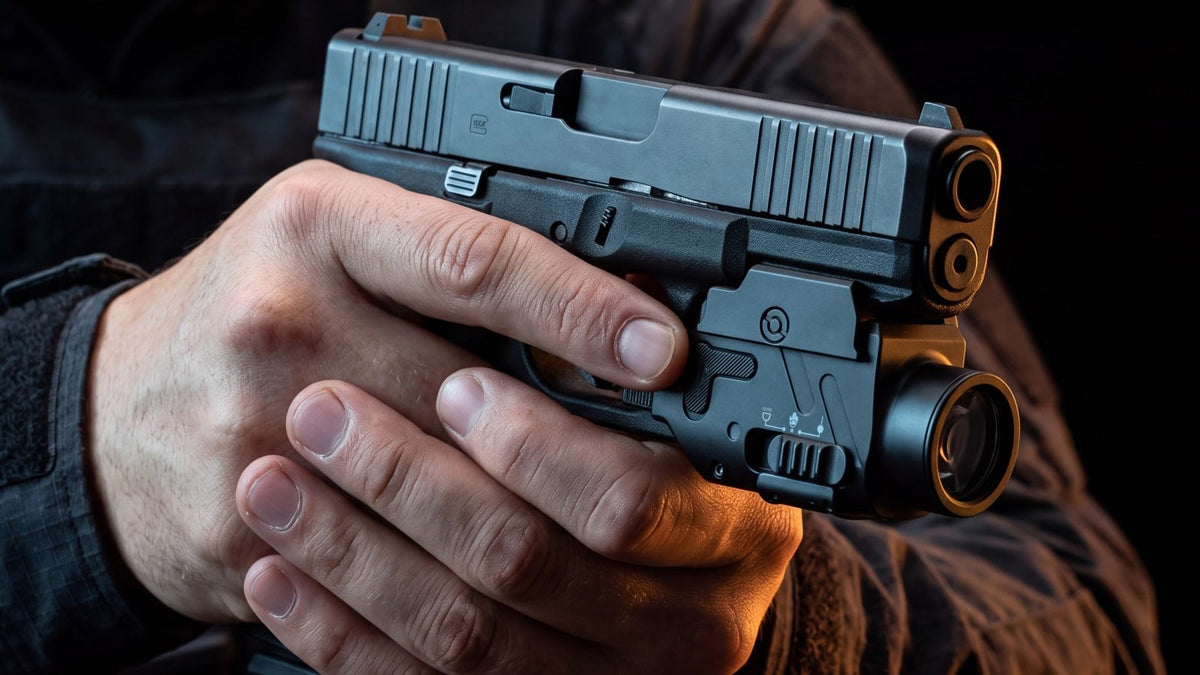

Yes — in most cases, a bigger flashlight lasts longer, because a larger body fits a larger battery with more stored energy. But size is not the whole story: a big light often runs brighter and draws more current, and a small light on low can outlast a big light on turbo. Capacity, output, and heat decide runtime.
- Size affects battery life mainly through the battery: a larger body fits a larger cell, and a larger cell stores more energy (watt-hours).
- Size also affects heat: a bigger body has more metal and surface area, so it heats up slower and holds turbo longer before stepping down.
- A bigger light does not automatically last longer — many big lights run brighter and draw more current, which eats the extra capacity.
- At the same output level, runtime scales roughly with capacity: double the milliamp-hours, roughly double the runtime.
- Pick size by job, not by spec sheet: pocket EDC for short tasks, a mid-size 18650 light for regular use, a 21700 light for long shifts and search work.
How Size Turns Into Runtime: Two Mechanisms
Flashlight size does not change battery life by magic. It works through two separate chains, and both are worth understanding because they point in the same direction — but for different reasons.
Chain 1: Bigger body, bigger cell, more stored energy
A flashlight's runtime is set by how much energy its battery stores, and how fast the light spends it. Energy is measured in watt-hours (Wh), and for a lithium-ion cell the formula is simple:
Energy (Wh) = capacity (mAh) × nominal voltage (V) ÷ 1,000
Most rechargeable flashlight cells run at a nominal 3.7 V. So a 1,500 mAh built-in battery — the size in the UltraFire SZ3 — stores 1,500 × 3.7 ÷ 1,000 = 5.55 Wh. A 3,000 mAh 18650 stores 11.1 Wh. A 5,000 mAh 21700 stores 18.5 Wh. Same voltage, same chemistry — the only difference is how much active material fits inside the cell.
And that is where body size comes in. Battery capacity is mostly a volume game: a bigger cell holds more material. Compare the two most common sizes. An 18650 is a cylinder 18 mm across and 65 mm long, with a volume of about 16,500 mm³ (π × 9² × 65). A 21700 is 21 mm across and 70 mm long, with a volume of about 24,200 mm³ (π × 10.5² × 70). That is roughly 47% more volume — and the typical top-end capacity rises from about 3,500 mAh to about 5,000 mAh, roughly 43% more. A flashlight body has to be at least as wide and as long as its cell, so a light built around a 21700 is necessarily bigger than one built around an 18650 — and it carries roughly 40% more energy.
The same logic explains the small end of the scale. An 18350 is the same 18 mm diameter as an 18650 but only 35 mm long — about half the volume — and typical capacities fall to 700–1,200 mAh. A flat EDC light with a built-in 1,500 mAh pack, like the SZ3, sits between an 18350 and an 18650 in stored energy. For a full size-by-size comparison, see our 18650 vs 21700 vs 18350 guide.
Chain 2: Bigger body, slower heating, longer turbo
The second chain has nothing to do with the battery. A flashlight turns most of its power into heat, and when the body gets too hot the light protects itself by stepping down to a lower output — thermal step-down. A larger body has more metal to absorb that heat and more surface area to shed it, so its temperature rises more slowly and turbo lasts longer before the step-down kicks in.
A small pocket light can hit its temperature limit in a minute or two on turbo; a larger light with the same LED and driver can hold the same output noticeably longer, simply because there is more metal to soak up the heat. This is the same mechanism behind the two step-down paths — heat and low voltage — explained in our guide to why flashlights get hot and step down. Size does not change the physics of the LED, but it changes how long the light can stay at full power before physics forces it to back off.
The Numbers: Common Cell Sizes Compared
The table below uses typical capacities for genuine cells from major makers, as published in battery size charts. Ranges are wide because capacity varies by cell model — high-drain cells trade some capacity for current output. The runtime column is an illustration, not a rating: it divides capacity by a steady 300 mA draw, the kind of current a mid-level mode might pull, before driver and heat losses.
| Battery | Size (mm) | Typical capacity | Stored energy (Wh) | Illustrative runtime at 300 mA draw |
|---|---|---|---|---|
| Built-in pack (SZ3) | Flat, pocket-size body | 1,500 mAh | 5.6 Wh (1,500 × 3.7 ÷ 1,000) | ~5 hours |
| 18350 | 18 × 35 | 700–1,200 mAh | 2.6–4.4 Wh | ~2–4 hours |
| 18650 | 18 × 65 | 2,600–3,500 mAh | 9.6–13.0 Wh | ~9–12 hours |
| 21700 | 21 × 70 | 4,000–5,000 mAh | 14.8–18.5 Wh | ~13–17 hours |
Two things stand out. First, the jump from a compact light to a mid-size 18650 light roughly doubles the stored energy — the biggest single step on the table. Second, real runtime is always less than the simple division suggests: the driver loses some energy as heat, output drops as voltage falls, and the ANSI FL1 runtime standard counts time until output falls to 10% of its initial value, not until the light goes dark. Read our ANSI FL1 explained guide for how those rated hours are actually measured.
Why a Bigger Light Doesn't Always Last Longer
The table above assumes the same current draw. In real life, bigger lights rarely draw the same current as small ones — and that is where the simple "bigger lasts longer" rule breaks down.
- Bigger lights are usually built to be brighter. A large search light may pull several amps on turbo to feed a bigger LED. Its 5,000 mAh cell can drain faster at 3,000 lumens than a small light's 1,500 mAh cell at 150 lumens. Capacity is the fuel tank; output is how hard you press the pedal.
- Mode matters more than size. A compact light on a 100-lumen low mode sips current and can run for many hours; a big light left on turbo can be done in under an hour. If runtime is the goal, dropping one mode level usually buys more time than buying a bigger light.
- Capacity labels can lie. Genuine 18650 cells top out around 3,500 mAh and genuine 21700 cells around 5,000 mAh. A cell claiming 9,900 mAh is not a better battery — it is a mislabeled one, and its real capacity is usually far lower. Buy cells from known makers and treat inflated numbers as a warning sign.
- Cold and age cut into every size. Lithium-ion cells deliver less usable capacity in the cold, and an old cell holds less charge than a new one whatever the label says. A fresh small cell can outperform a tired big one.
How to Pick the Right Size for Your Use
Size is a trade-off between runtime and carryability, so start from the job, not the spec sheet:
- Pocket EDC and short tasks — a flat light with a built-in 1,500 mAh-class battery, or a compact 18350 light. Enough for finding things, walking the dog, and short repairs. Recharge it often; it is not built for all-night use.
- Regular work, inspection, and night walks — a mid-size 18650 light. Roughly double the energy of a compact light, still pocketable, and the replaceable cell means you can carry a charged spare instead of waiting for a recharge.
- Long shifts, search work, and camping — a 21700 light. The largest common single cell, with the longest runtime per charge and the most metal to hold turbo. The cost is size and weight, and a longer recharge: a bigger cell takes proportionally longer to fill at the same charging current. See our USB-C charging guide for how charge time is calculated.
One practical habit beats any size choice: if your light takes a replaceable cell, carry a charged spare; if it has a built-in battery, carry a small power bank and a USB-C cable. A spare beats a bigger light when the job runs longer than planned.
- Only use the battery size your light is designed for. Never force a larger cell into a light built for a smaller one, and never improvise with spacers or adapters.
- Check the manual before swapping cells. Some lights accept only button-top or only flat-top cells, and some need protected cells. The wrong fit can break contact or damage the light.
- Retire damaged cells. A cell with a torn wrapper, dent, or swelling should not be used — replace it.
Frequently Asked Questions
Does a bigger flashlight always last longer?
No — only at the same output level. A bigger flashlight usually lasts longer because it fits a bigger battery with more watt-hours, and its larger body sheds heat better. But many big lights are built to run brighter, and a bright mode drains the extra capacity fast. A small light on low can outlast a big light on turbo. Compare runtime at the output you will actually use, not at maximum.
Does a bigger battery make a flashlight brighter?
No. Battery capacity is like the size of a car's fuel tank: a bigger tank lets you drive farther, not faster. Brightness is set by the LED, the driver circuit, and the current they are designed to draw. A bigger cell gives you more runtime at the same brightness, and it can sustain high output longer because it sags less under load — but it does not raise the light's maximum output by itself.
Can I put a bigger battery in my flashlight for more runtime?
Only if the light is designed for that size. An 18650 will not fit in a light built for an 18350, and a 21700 will not fit in a light built for an 18650 — the bodies are different diameters and lengths. Use only the cell size listed in the manual. If you want more runtime from a light with a replaceable cell, carry a charged spare of the correct size instead.
Why do small flashlights step down from turbo faster?
Because they have less metal to absorb heat and less surface area to shed it. On turbo, the LED generates heat faster than a small body can get rid of it, so the light reaches its temperature limit quickly and steps down to protect itself. A larger body heats up more slowly, so it can hold turbo longer. The step-down is normal thermal protection, not a defect.
Does a bigger flashlight take longer to charge?
Yes, roughly in proportion to capacity. Charge time is approximately capacity divided by charging current: a 5,000 mAh cell takes about three times as long as a 1,500 mAh cell at the same charging current. USB-C fast charging narrows the gap, but it does not remove it — a bigger battery still needs more energy put back in. Lights with replaceable cells sidestep this entirely: swap in a charged spare and keep going.
Two Lights That Show Both Ends of the Scale
The SZ3 is the compact end: a flat, pocketable light with a built-in 1,500 mAh battery. The RUV3 is a larger, full-size light with a 4.5-hour rated runtime. Neither is "better" — they are built for different jobs, and the size difference is the reason.

UltraFire SZ3 Swivel Head EDC Flashlight | 1300LM CRI90+
The compact end of the scale: a flat, pocket-size work light that trades some runtime for a body that disappears in a pocket — then makes up for it with a swivel head and magnetic tail that keep the light where the work is.
- 1,300 lumens, high-CRI 90+ for true colors
- 0–100° swivel head with spot + flood dual beams
- Built-in 1,500 mAh battery (5.6 Wh), USB-C charging
- Magnetic tail for hands-free mounting
- IPX6 waterproof, 1-meter drop resistance, 3-year warranty
- $55.99

UltraFire RUV3 365nm UV Flashlight | ZWB2 Filter, 10W
The larger-body end of the scale: a full-size UV light whose bigger body and battery deliver a 4.5-hour rated runtime for long sessions in the field — mineral checks, scorpion hunting, and inspection work that does not fit in a quick pocket-light outing.
- True 365nm UV with high-performance ZWB2 filter
- 10W output, dual modes
- 4.5-hour rated runtime
- $49.99
Final Thoughts
Flashlight size affects battery life through two honest mechanisms: a bigger body fits a bigger battery with more watt-hours, and more metal sheds heat better, so turbo lasts longer. Both are real, and both have limits — a big light built to run bright can still drain fast, and a small light on a low mode can run for hours. So buy the size that matches the job, read the runtime at the output you will actually use, and carry a spare cell or a power bank when the night might run long.