
Every October, Earth plows through debris left behind by Halley's Comet, and bits of it burn up overhead as the Orionid meteor shower. The 2026 peak lands on the night of October 21–22, and while the Orionids won't rain fire like the Perseids, they are some of the fastest, most dramatic meteors of the year — streaking across the sky at 66 kilometers per second and often leaving glowing trails that linger for a second or two. Seeing them takes one thing above all: patience under a dark sky, with your night vision intact. Here is how to catch the peak, and the flashlights that belong in a meteor-watcher's kit.
- The Orionids peak on the night of October 21–22, 2026 — debris from Halley's Comet burning up at 66 km/s.
- Expect 10–20 meteors per hour from a dark site; the best window is after moonset until dawn, with rates good a night either side of the peak.
- Eyes take 20–30 minutes to fully adapt to the dark — one blast of white light resets the clock, so use dim, downward-aimed light.
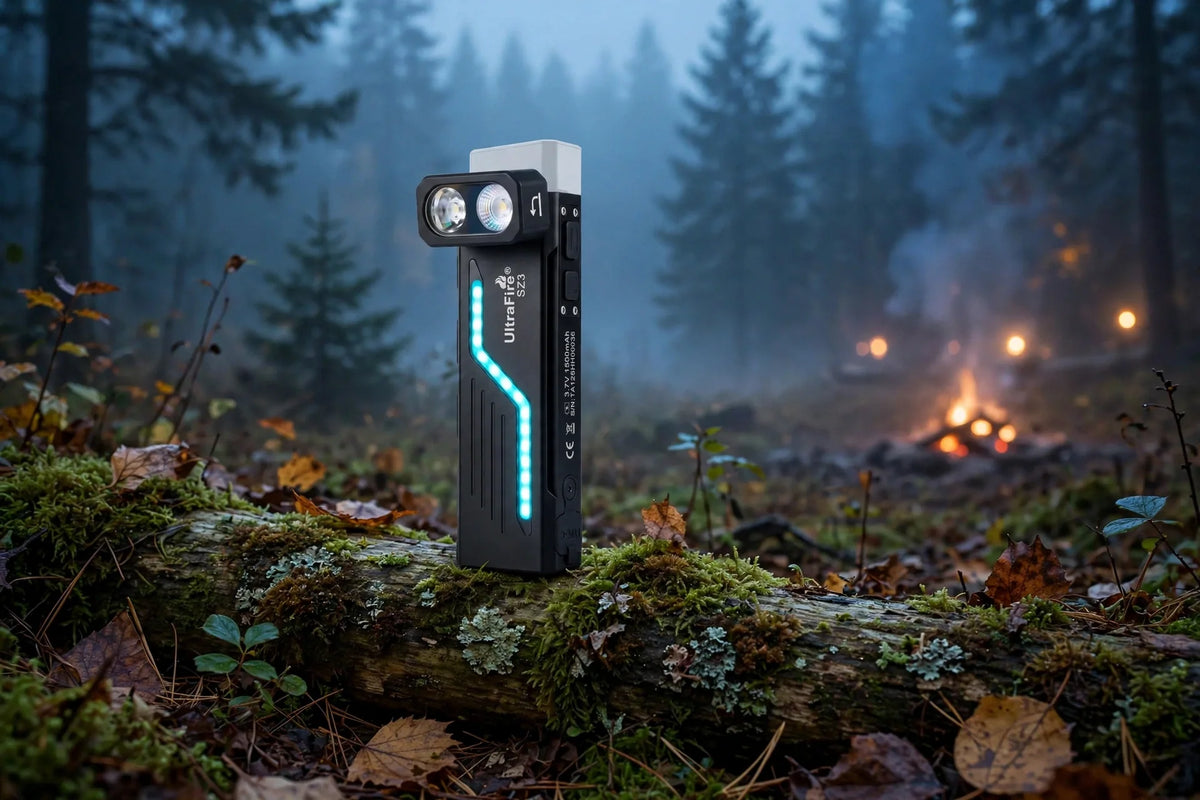
- UltraFire SZ3: 1,300-lumen swivel-head EDC light — low and ambient modes for camp use without wrecking night vision.
- UltraFire RUV3: 365nm UV light — scan desert ground for scorpions while you wait between meteors.
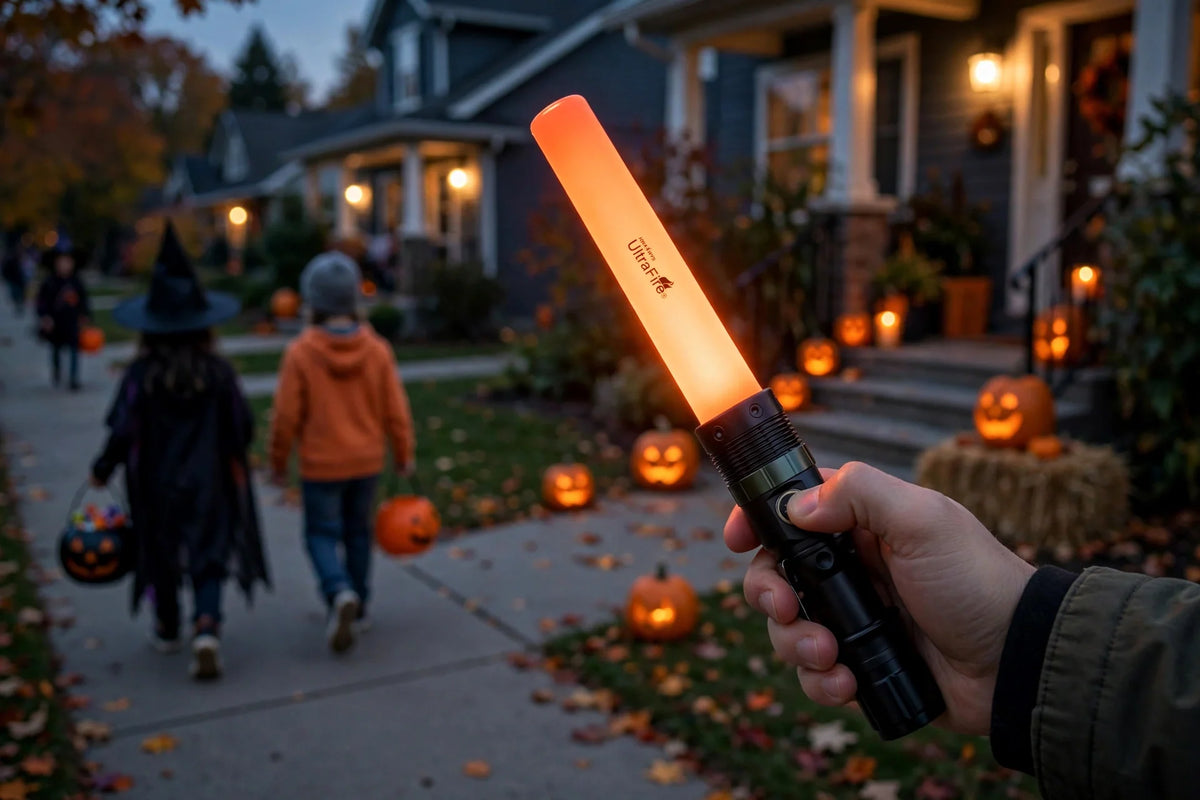
- UltraFire UF-303X: 2-in-1 signal wand — mark your tent and stay visible driving back from the dark site.
When to Watch: The October 21–22 Peak
The Orionids are active from October 2 to November 7, but the peak falls on the night of Wednesday, October 21 into the early hours of Thursday, October 22, 2026. Under a dark rural sky you can expect about 10–20 meteors per hour — a steady show, not a downpour.
- Go late, not early. A waxing gibbous moon will be about 80% lit and hangs in the sky until after midnight, washing out fainter meteors. Once the moon sets, the sky darkens noticeably and the last stretch of darkness before sunrise is the window that counts.
- Look away from Orion. The meteors appear to radiate from near Betelgeuse, Orion's orange shoulder star, which rises in the east and climbs high in the south before dawn. But the longest, most dramatic trails show up 45 to 90 degrees away from the radiant — take in as much sky as you can.
- Give it an hour. Your eyes need 20–30 minutes to fully adapt to darkness, and meteor watching rewards patience. Recline, dress warm, and let the sky do its thing.
- Get away from city lights. Artificial light drowns out faint meteors. Even a 20-minute drive to a darker spot transforms the show.
Protect Your Night Vision: The 20-Minute Rule
Here is the part most first-time meteor watchers learn the hard way. Your eyes take 20–30 minutes to reach full dark adaptation — and a single glance at a bright phone screen or a blast from a high-beam flashlight resets that clock back to zero.
- Use the lowest mode that gets the job done. A dim mode for finding your chair or checking your watch is all you need. Save the bright beam for emergencies.
- Aim light downward, never across the field. Point beams at the ground or into your lap, never toward where people are reclining and looking up.
- Amber or low white beats bright white. Dimmer, warmer tones disturb adapted eyes far less than a full-power white blast.
- Shield the glow. Cup the light in your hand or angle a swivel head away from the viewing area so only the ground is lit.
This is exactly the job a good camp light handles: dim usable output, aimed where you need it, and nothing leaking into anyone's sky.
UltraFire SZ3: A Meteor Watcher's Camp Light
The SZ3 earns its place in the meteor kit for one reason: control. The 0–100° swivel head lets you aim low modes straight at the ground or into the tent while everyone around you keeps their night vision. Use the low white modes or the soft ambient light effects for camp chores — setting up chairs, pouring coffee from the thermos, finding the blankets — without flashing the field. When the session is over and it's time to break camp, the full 1,300-lumen output and the flood beam get everything packed fast.

UltraFire SZ3 Swivel Head EDC Flashlight | 1300LM CRI90+
The meteor watcher's camp light: aim the swivel head down at low modes while everyone watches the sky, then switch to full power for teardown. The magnetic tail sticks to the car roof or a chair frame for hands-free light.
- 1,300 lumens, high-CRI 90+ for true colors
- 0–100° swivel head with spot + flood dual beams
- Low modes and ambient light effects for night-vision-friendly camp use
- Magnetic tail for hands-free mounting
- 1,500 mAh battery, USB-C charging (works while charging on low)
- IPX6 waterproof, 1-meter drop resistance, 3-year warranty
Why it fits meteor night: Swivel head keeps light on the ground, low modes protect dark adaptation, and the magnet holds it to the car while you carry gear.
Desert Bonus: Scan for Scorpions While You Wait
The best meteor watching in the American West happens in the desert — Joshua Tree, Death Valley, the Arizona outback — where the sky is darkest. Those same deserts are scorpion country, and scorpions fluoresce an eerie blue-green under 365nm ultraviolet light. During the quiet stretches between meteors, sweep the UV beam across the ground around your chairs and tent. It is a genuinely fun side activity, and it is also the practical way desert campers check where they are about to sit or step.

UltraFire RUV3 365nm UV Flashlight
The between-meteors activity: a real 365nm UV light with a ZWB2 filter that cuts visible-light leakage, so fluorescence stands out. Sweep the desert floor for scorpions, or check tents and gear at night.
- True 365nm UV output with ZWB2 filter
- 10W for wide-area UV scanning
- USB-C rechargeable
Why it fits meteor night: Desert dark-sky sites are prime Orionid territory and scorpion country alike — one light covers both jobs.
UltraFire UF-303X: Mark Your Camp, Drive Back Safe
Dark-sky spots are usually at the end of a dark road. The UF-303X is a 2-in-1 tool: a regular flashlight plus a detachable signal tube that turns it into a traffic wand. Stand it by your tent as a low, visible camp marker so friends find you in the dark, and use the wand for visibility during roadside stops on the drive home. The 2-pack bundle ($46.99) covers both ends — one for the campsite, one for the car.

UltraFire UF-303X Rechargeable Traffic Wand
One light, two jobs: a dependable flashlight for seeing, and a bright signal wand for marking your camp or staying visible on a dark roadside.
- 2-in-1 design: flashlight + detachable signal tube
- USB-C rechargeable — no spare batteries to hunt for
- IPX6 waterproof for desert nights and damp ground
- Available in 1-pack ($27.99) and 2-pack bundle ($46.99)
SZ3 vs. RUV3 vs. UF-303X: Which One Is Right for You?
| Feature | SZ3 | RUV3 | UF-303X |
|---|---|---|---|
| Role on meteor night | Night-vision-friendly camp light | UV scorpion scanning | Camp marker & roadside visibility |
| Standout feature | 0–100° swivel head, magnetic tail | True 365nm UV, ZWB2 filter | Detachable signal tube (2-in-1) |
| Brightness / output | 1,300 lumens | 10W UV | Signal wand + flashlight |
| Charging | USB-C | USB-C | USB-C |
| Water resistance | IPX6 | — | IPX6 |
| Price | $55.99 | $49.99 | $27.99 (2-pack $46.99) |
Choose the SZ3 if you want one light that handles camp chores without ruining anyone's night vision.
Choose the RUV3 if you are watching from desert country and want the scorpion-scanning side activity.
Choose the UF-303X if marking your camp and staying visible on dark roads matters to you.
Bringing all three covers the full night: watch, scan, and get home. Browse the full lineup in the UltraFire collection.
Your Meteor Night Kit Checklist
- Reclining chair or sleeping pad — you'll be looking up for an hour or more
- Warm layers and a blanket (desert nights drop fast, even after warm days)
- SZ3 or similar low-mode-capable light for camp use
- RUV3 UV light if you're in scorpion country
- UF-303X as a camp marker and for the drive home
- Power bank + USB-C cables — recharge lights from the car on the way out
- Snacks and a thermos — meteor watching is better with coffee
- Star map app or a simple constellation printout (Orion rises in the east)
- Red-tinted map light or keep phone screens dim and face-down
Give Yourself the Full Hour
Most people give up after fifteen minutes, right when their eyes are finally adapting. The Orionids are a slow-burn shower — the best meteors often come in quiet clusters. Set a timer for an hour, recline, and let the adaptation happen. Your patience is the most important piece of gear you bring.
- Drive like it's midnight — because it is. Dark roads, drowsy drivers, and wildlife. Slow down on the way out and back.
- Never aim beams at people or cars. Flashlights can startle drivers and wreck other watchers' night vision.
- Watch where you sit and step. In the desert, check the ground with UV light before settling in.
- Dress warmer than you think. Hypothermia starts with shivering; October desert nights can drop 30°F from daytime.
- Tell someone where you are. Remote dark-sky spots often have no cell signal.
- Leave no trace. Pack out everything you carried in, including batteries and packaging.
Final Thoughts
The Orionid peak on October 21–22 is a midweek excuse to do something most people never do: drive somewhere dark, lie back, and watch pieces of Halley's Comet burn up at 66 kilometers per second. Protect your night vision, bring a low light you can control, and let the sky do the rest.
Ready to gear up? Start with the SZ3 for the camp, add the RUV3 for desert scanning, and mark your site with a UF-303X.