
Two flashlights can both advertise a big lumen number and still behave very differently in your hand. One throws a tight beam down a trail, the other floods a workbench with soft light, and one of them dims after a few minutes while the other runs for hours. The difference is rarely the headline number. It is how the numbers were measured. The ANSI/NEMA FL1 standard exists to give those measurements a shared definition, so a lumen means the same thing on one box as it does on another. This guide explains the six FL1 measurements, what each one can and cannot tell you, and how to read a spec sheet without being misled by a single big number.
- ANSI/NEMA FL1 defines six measurements: light output, peak beam intensity, beam distance, runtime, impact resistance, and water resistance.
- Lumens measure total light; candela measures the highest-intensity point in the beam. A light can be high in one and modest in the other.
- Beam distance is the point where the beam falls to 0.25 lux, roughly full-moon light — not the point where the beam disappears.
- Runtime runs until output falls to 10% of its starting value, so a long runtime does not mean hours at full brightness.
- Read water and impact ratings as specific tests (IPX level, drop height), not as vague words like "waterproof" or "tough."
- UV lights are a special case: they are rated by wavelength and power, not by lumens.
Why Spec Sheets Are So Confusing
Most of the confusion comes from three habits. First, brands lead with the biggest number they have, usually a short turbo burst measured in the first seconds after switch-on. Second, different makers test under different conditions, so two "1,000-lumen" lights may not have been measured the same way. Third, a single number hides trade-offs: a light tuned for distance gives up flood, and a light tuned for long runtime gives up peak brightness. FL1 does not ban big numbers. It pins down what each number means, so you can compare lights on the same terms.
One more point worth knowing: FL1 is a measurement standard, not a quality stamp. A light can report FL1-style figures and still be a poor fit for your job. Use the six measurements as a checklist, then match them to what you actually do with the light.
The Six FL1 Measurements, One by One
1. Light Output — Lumens
Light output is the total amount of visible light a flashlight emits in all directions, measured in lumens with an integrating sphere. Under FL1, the measurement is taken 30 seconds after switch-on, once the output has settled from its initial burst. That 30-second rule matters: it stops a maker from reporting a brief peak that the light cannot hold.
What lumens tell you: how much light the lamp produces overall. What they do not tell you: where that light goes. A wide flood beam and a narrow throw beam can share the same lumen figure and light up a room in completely different ways.
2. Peak Beam Intensity — Candela
Peak beam intensity is the brightness at the highest-intensity point of the beam, measured in candela at the beam center. Unlike lumens, which add up all the light, candela describes concentration: how tightly the optics focus the light into one spot.
What candela tells you: how punchy the center of the beam is, which is the main driver of throw. What it does not tell you: how wide or useful the rest of the beam is. A very high candela figure with a narrow beam can be awkward for close-up work, where you want spill light around the hotspot.
3. Beam Distance — Meters
Beam distance is the distance at which the beam's brightness falls to 0.25 lux, about the light of a full moon on a clear night. It is calculated from peak beam intensity, not measured by walking away until you cannot see the beam: distance in meters equals the square root of candela divided by 0.25.
For example, a beam with a peak intensity of 10,000 candela gives a beam distance of 200 meters (the square root of 10,000 / 0.25). That is a defined threshold, not a promise that you will see clearly at 200 meters. In practice, usable detail fades well before the rated distance, because 0.25 lux is dim. Treat beam distance as a comparison figure between lights, not as a working range.
4. Runtime — Hours
Runtime is the time from the 30-second starting value until output falls to 10% of that value, measured on a continuous run. This is the measurement most often misunderstood. A light rated for 10 hours has not necessarily run at full brightness for 10 hours. Most lights step down from turbo to a lower, sustainable level, and the clock keeps running as output fades toward the 10% cutoff.
What runtime tells you: how long the light keeps producing usable light on that mode. What it does not tell you: the shape of the output curve. Two lights with the same runtime can feel very different — one may hold a steady medium level, the other may start bright and fade gradually. If a maker publishes a runtime graph, read it alongside the headline hours.
5. Impact Resistance — Meters
Impact resistance is the drop height, in meters, from which a light can be dropped onto concrete and still work. Under FL1, samples are dropped six times from the rated height, and the light must remain functional with no cracks or breaks that impair operation.
What it tells you: a tested level of drop durability, expressed as a height rather than a vague claim. What it does not tell you: that the light is indestructible, or that repeated drops over years will have no effect. A 1-meter rating is a meaningful everyday benchmark — roughly a fall from hand height — but it is a test result, not a guarantee against every accident.
6. Water Resistance — IPX Rating
Water resistance under FL1 follows the IEC 60529 IPX scale, with three levels commonly seen on flashlights: IPX4 means splashes from any direction have no harmful effect; IPX7 means the light can be immersed in 1 meter of water for 30 minutes; IPX8 means continuous immersion deeper than IPX7, under conditions the maker states. IPX6, also common on work and outdoor lights, covers powerful water jets — the kind of rating that holds up in heavy rain and washdown conditions.
What the rating tells you: exactly which water test the light passed. What it does not tell you: that every light with a water rating handles every wet situation. Rain, splashes, and immersion are different tests. Match the rating to the wettest condition you realistically expect, and remember that seals age — a rating describes the light as tested, not after years of wear.
Lumens vs. Candela: A Worked Example
Imagine two lights that both advertise 1,000 lumens. One uses a wide optic that spreads the light into a broad flood; the other uses a deep reflector that concentrates it into a tight hotspot. The flood light will have modest candela and a short beam distance, while the throw light will have high candela and a long beam distance — same lumens, very different beams.
That is why reading lumens alone leads to bad buys. For close work — repairs, camping chores, reading a map — flood and a comfortable medium mode matter more than throw. For spotting something at distance, candela and beam distance matter more than total lumens. Decide which job comes first, then read the matching measurement.
Three Lights, Read Through the FL1 Lens
The lights below are current UltraFire models. Their published specs are not FL1 certificates, but they map neatly onto the six-measurement checklist, which makes them useful examples of how to read a spec sheet in practice.

UltraFire SZ3 Swivel Head EDC Flashlight | 1300LM CRI90+
The work-light example: a swivel head and magnetic tail for hands-free aiming, plus the two ratings to check on any work light — water resistance and drop resistance.
- 1,300 lumens, high-CRI 90+ for true colors
- 0–100° swivel head with spot + flood dual beams
- Magnetic tail for hands-free mounting
- 1,500 mAh battery, USB-C charging (works while charging on low)
- IPX6 water resistance, 1-meter drop resistance, 3-year warranty
- $55.99

UltraFire UF-303X Rechargeable Traffic Wand
The visibility example: FL1 measures seeing light, not signaling light, so judge this one on both — its flashlight specs and its detachable signal tube for being seen.
- 2-in-1 design: flashlight + detachable signal tube
- USB-C rechargeable
- IPX6 water resistance for wet roadside conditions
- $27.99

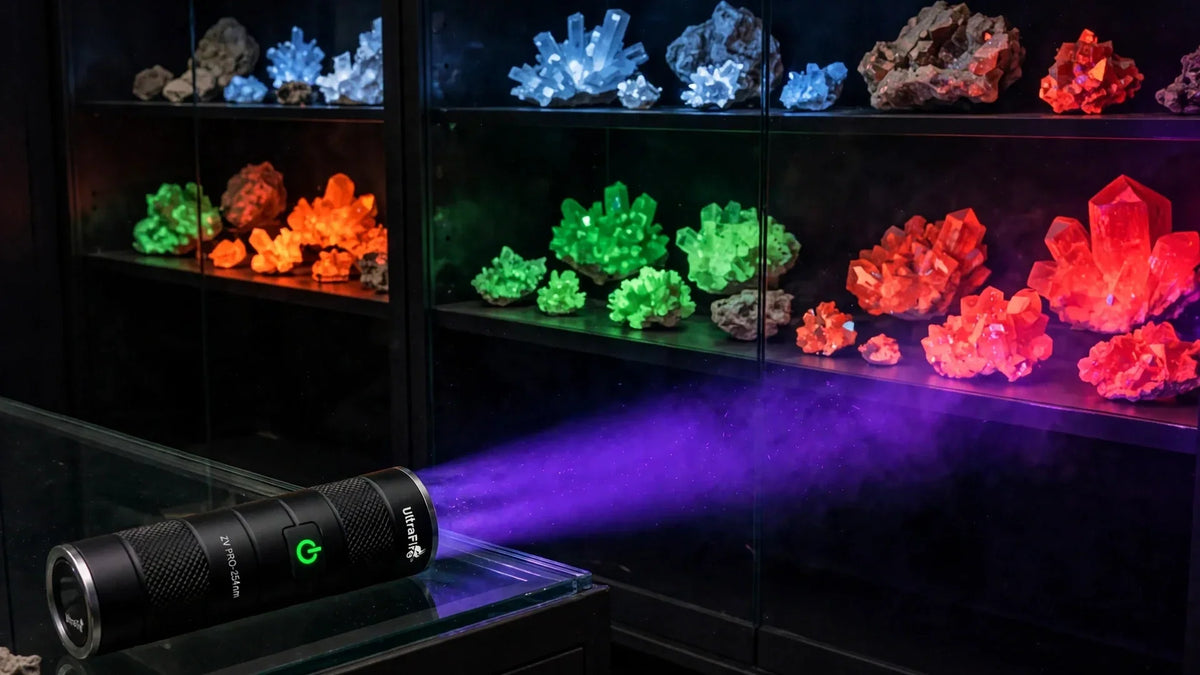
UltraFire RUV3 365nm UV Flashlight | 10W
The exception that proves the rule: UV lights are rated by wavelength and power, not by lumens, because lumens measure visible light. For UV work, check the wavelength first, then the filter.
- True 365nm wavelength with ZWB2 filter for clean UV output
- 10W output
- Focused beam for detail and detection work
- $49.99
The Six Measurements at a Glance
| Measurement | Unit | What it tells you | Trap to watch |
|---|---|---|---|
| Light output | Lumens | Total light emitted, measured at 30 seconds | Says nothing about beam shape or throw |
| Peak beam intensity | Candela | Brightness at the beam's center | A narrow hotspot can look strong and still be poor for close work |
| Beam distance | Meters | Distance to the 0.25 lux threshold | Usable detail fades well before the rated distance |
| Runtime | Hours | Time until output falls to 10% of its start | Does not mean hours at full brightness; step-down counts |
| Impact resistance | Meters | Drop height survived on concrete (six drops) | A test result, not a promise against every accident |
| Water resistance | IPX rating | Which water test was passed (splash, jets, immersion) | Rain and immersion are different tests; check the exact level |
Spec-Sheet Checklist: Read in This Order
- Start with the job. Close work favors flood, candela-light beams, and a good medium mode; distance work favors candela and beam distance.
- Check lumens and candela together. High lumens with low candela means flood; modest lumens with high candela means throw.
- Read runtime as "until 10%," not "at full power." If you need steady light for hours, look for a stated medium-mode runtime or an output graph.
- Translate beam distance. Halve the rated distance in your head for a rough sense of where detail stays clear — and compare lights at the same threshold.
- Read water and impact as tests. Note the exact IPX level and the drop height in meters, and match them to the worst conditions you expect.
- Watch for missing measurements. A sheet that gives only lumens, with no candela, runtime, or water rating, is asking you to buy on one number.
- For UV lights, switch checklists. Wavelength first (365nm for most detection and curing work), then filter and power — lumens do not apply.
- Never point any flashlight beam at anyone's eyes, and do not stare into a beam to "test" its brightness.
- Keep UV beams away from eyes and skin, and do not use a UV light as a toy. The beam can look dim while still emitting UV.
- Do not open, modify, or short-circuit a rechargeable flashlight. If a light is damaged, swollen, or has a cracked lens, stop using it and contact the seller.
- Charge with a suitable USB-C source and do not leave a charging light unattended for long periods.
Final Thoughts
FL1 will not pick your flashlight for you, and that is the point. It gives you six defined questions to ask of any spec sheet: how much light, how focused, how far to a dim threshold, how long until it fades, how far it can fall, and how wet it can get. A light that answers all six, in numbers you can compare, is easier to trust than a light that shouts one number and hides the rest. Start with your job, read the matching measurements, and let the rest of the sheet fill in the picture — not replace it.