
A fluorescent mineral collection lives two lives. On the shelf in daylight, most specimens look like ordinary gray-brown rock. Kill the room lights, switch on the right ultraviolet wavelength inside a dark display case, and the same stones light up red, green, orange, and blue. Getting that second life to show up in a case at home is mostly a lighting problem — and it starts with understanding what fluorescence is, why wavelength matters more than raw power, and how much UV output a case of a given size actually needs.
Why Minerals Glow: Fluorescence in Plain Terms
Fluorescence happens when a material absorbs energy at one wavelength and gives part of that energy back as visible light. Shine ultraviolet light on a fluorescent mineral and it soaks up the invisible UV, then re-emits a portion of it at a longer, visible wavelength. Turn the UV off and the glow stops instantly — that on/off behavior is what separates fluorescence from phosphorescence, the slow afterglow of a glow-in-the-dark toy.
The colors are not random decoration. They usually come from trace impurities — tiny amounts of a foreign element locked inside an otherwise plain mineral. Manganese is the classic example: calcite carrying traces of manganese (with a little lead) glows in shades of red, from dull brick to fiery crimson. Silicate minerals such as quartz, agate, and common opal that picked up trace amounts of uranium — sometimes only a few parts per million — respond with a strong yellow-green. Change the trace element and you change the color, which is why two pieces of calcite from different localities can glow completely different colors under the same lamp.
Three Wavelength Bands, Three Different Shows
Collectors divide ultraviolet into three working bands, and each one excites a different set of minerals:
- Shortwave (SW), UV-C, centered on 254nm. This is the band where many classic display minerals respond most strongly. Scheelite, for example, glows a bright blue-white under 254nm, and a large share of the famous Franklin and Sterling Hill, New Jersey material — red calcite, green willemite — is shown under shortwave.
- Midwave (MW), UV-B, around 310nm. The most overlooked band. Some specimens that look modest under shortwave or longwave come alive here, and many minerals shift color: scheelite that is blue-white under 254nm can show pastel yellow, pink, or blue under midwave.
- Longwave (LW), UV-A, centered on 365nm. The band of common blacklights and most UV LED flashlights. Plenty of minerals respond well to 365nm, and it is the practical starting point for most collections — but it is only one-third of the picture.
The catch is that a mineral's response can be very specific to wavelength. A well-known calcite from Mexico is the standard demonstration: it fluoresces bright blue-white under 254nm shortwave, yellow under midwave around 310nm, and hot pink under longwave at 365nm. Three wavelengths, three different specimens — from one rock. That is why serious collectors do not rely on a single blacklight. If your case is lit with only one band, you are seeing only part of what your collection can do.
Sizing UV Light to Your Display Case
In a display case, more UV output is better — but how much you need scales with the case, and distance is the reason. UV intensity falls off quickly as the lamp gets farther from the specimens, so case geometry decides your lighting budget:
- Small cases (about a 1-foot cube). Modest UV output is enough. The lamp sits close to every specimen, so even a low-power source produces a satisfying glow. This is the one size where a small light genuinely keeps up.
- Standard cases (roughly 2 ft tall × 2 ft deep × 4 ft wide). This is where collectors get surprised. A mid-output source lights the middle of the case well, but the specimens at both ends sit noticeably dimmer — the edges are farther from the lamp and off its axis. The practical fixes are stronger output, a second light aimed from the other side, or placing your brightest-responding specimens at the ends where the light is weakest.
- Tall cases. Raising the lamp higher above the specimens increases the distance to everything below it, so a taller case demands still more output to keep the bottom shelf glowing. If you raise the light, budget for more UV.
Working with handheld LED UV lights instead of a fixed fixture? The same physics applies, and it works in your favor: you can bring the light close to each specimen, sweep it across the case from several angles so no piece hides in a shadow, and darken the room so ambient light does not compete with the glow. For photographing or showing a collection, a slow pass at close range with a 254nm, a 310nm, and a 365nm light in turn beats any single lamp parked at a distance.
Why Filter Glass Matters as Much as the Light
Every practical UV source leaks a little visible light along with its ultraviolet output. That stray visible light lands on your specimens at the same time as the UV, and it competes with the fluorescence — colors look pale, diluted, washed out. Filter glass solves this by sitting in front of the source: it blocks the visible portion of the output while letting the ultraviolet pass through to the minerals.
Two things are worth knowing about filters. First, filtering is not free: some UV is always lost in the glass, and the loss is bigger at shortwave. Passing 254nm through filter glass is genuinely hard, so a shortwave setup delivers a smaller share of its raw UV to the specimen than a longwave setup does — one more reason shortwave display lighting needs headroom in output. Second, a good filter is what separates a true 365nm light from a cheap violet one. The UltraFire 502UV PRO ($25.99), for example, uses a ZWB2 filter to cut the visible spill from its 365nm output, so the fluorescence you see is the mineral's color — not the lamp's.
Building a Three-Wavelength Setup
Covering all three bands does not require a museum fixture budget. A practical collector's kit pairs one light per band:
- Shortwave: the UltraFire ZV PRO-254nm covers the 254nm band where classic display minerals respond best.
- Midwave: the UltraFire ZV PRO-310nm fills the 310nm gap that most single-light collections are missing.
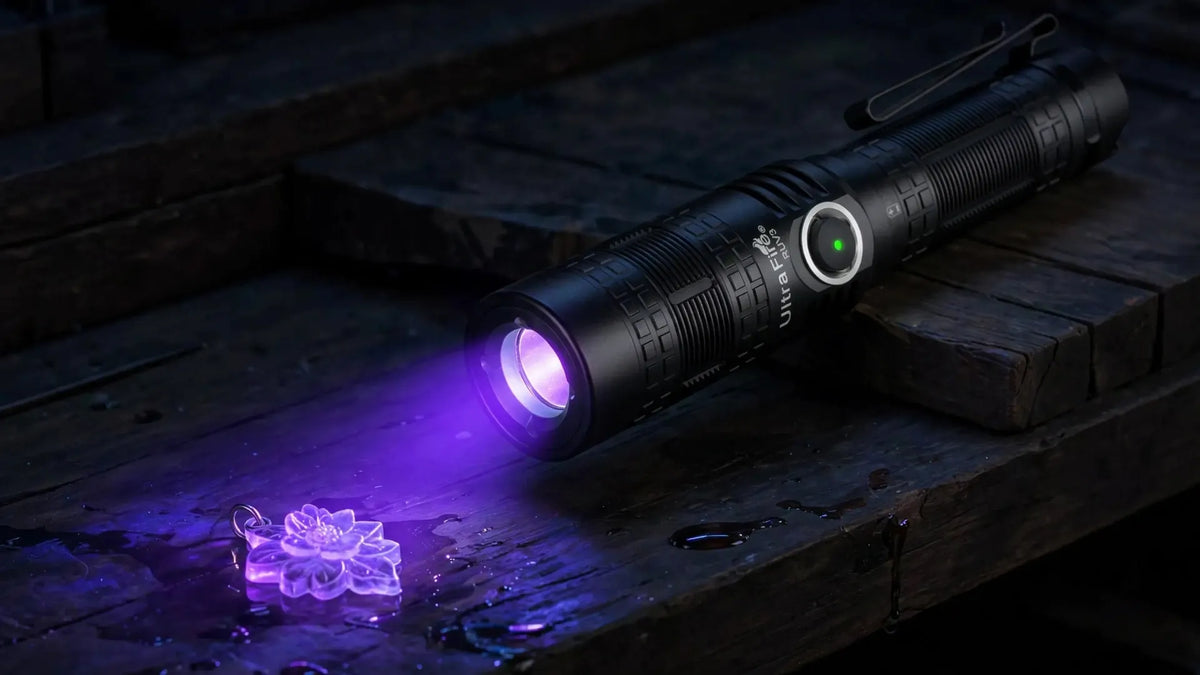
- Longwave: the UltraFire RUV3 ($49.99) is a 365nm workhorse for everyday viewing, and the 502UV PRO above adds a ZWB2-filtered 365nm option.
With one light in hand at a time, go through your case shelf by shelf and watch which specimens change character as you switch bands. That rotation — not a bigger single lamp — is what makes a home display feel like the museum cases in Franklin.
Safety Basics for UV Viewing
Ultraviolet deserves the same respect you would give any strong light source. Wear UV-blocking safety glasses whenever you view or photograph specimens, especially under shortwave. Never point a UV light at people or pets, and never stare directly into the source. Keep sessions sensible: light the case, enjoy the show, and switch off when you are done. For a permanent display case, a UV-blocking transparent front panel lets visitors enjoy the glow while keeping the UV inside the case where it belongs.
FAQ
Which wavelength should I buy first for a mineral display?
Start with the band your specimens respond to. If you collect classic Franklin-style material, shortwave 254nm does the heavy lifting. If you are unsure, add midwave 310nm second — it is the band most collections lack — and round out the case with 365nm longwave.
Why do the specimens at the ends of my case glow dimmer?
Distance and angle. The ends are farther from the lamp and off-center, so they receive less UV. Add a second light, raise the output, or move your brightest-responding specimens to the ends.
Is a filtered 365nm light really different from a cheap blacklight?
Yes. Unfiltered sources leak visible violet light that washes the fluorescence out. A ZWB2 filter blocks that visible spill, so colors look deeper and weaker responses become visible.
Can one mineral really glow different colors?
Yes — the Mexican calcite example above shows blue-white under 254nm, yellow under 310nm, and hot pink under 365nm. The mineral does not change; the wavelength exciting it does.
Ready to light your collection properly? Browse the full range in our UV flashlights for fluorescent minerals collection and pick the bands your case is missing.