
IPX6, IP68, IPX4 — flashlight listings are full of these codes, and they all sound like the same promise: this light can handle water. They are not the same promise. An IP rating is a short code for a specific laboratory test, and each code describes a different kind of contact with dust and water. Read it correctly, and you can tell whether a light is built for a rainy walk, a wet job site, or an accidental drop in a puddle. Read it as a general claim that a light is “waterproof,” and you may expect far more than the test ever proved.
- An IP code has two digits: the first rates protection against solids and dust, the second rates protection against water. X means that digit was not tested or not rated — not zero.
- IPX4 handles splashing water from any direction. IPX6 handles powerful water jets. IP68 is dust-tight and rated for immersion deeper than 1 meter, under conditions the manufacturer must specify.
- A higher number is not a blanket upgrade: an immersion rating does not by itself prove jet resistance, and a jet rating does not by itself prove the light survives 30 minutes underwater.
- Tests use clean, fresh water in a lab. Salt water, soapy water, steam, and moving water are different problems, and seals wear with drops and age.
- UltraFire SZ3 and UltraFire UF-303X are both rated IPX6 — built for heavy rain and powerful splashes, not for swimming or diving.
How to Read an IP Rating
IP stands for Ingress Protection, and the code comes from the international standard IEC 60529. The format is always the same: the letters IP, followed by two characters. Each character answers a separate question.
- First character — solids and dust. A digit from 0 to 6. The higher the number, the smaller the object or particle the enclosure keeps out.
- Second character — water. A digit from 0 to 9. The higher the number, the more severe the water test — but, as explained below, the tests are different in kind, not just in degree.
- X in either position means that protection was not rated for that digit. IPX6 says nothing at all about dust, because the dust digit was not assigned. It does not mean the light has no dust protection; it means dust protection was not part of that rating.
Flashlight specifications often cite the ANSI FL1 standard alongside the IP code. ANSI FL1 is the testing standard for flashlight performance claims such as output, runtime, and beam distance, and it reports water resistance using the same IP codes. The code itself is still the part that tells you what was tested.
The First Digit: Dust and Solids
For most flashlight buyers, the first digit matters in dusty workshops, on construction sites, and anywhere fine grit gets into everything. Only the top two ratings are commonly relevant for a sealed flashlight, but the full scale helps the code make sense.
| First digit | What it means | Plain-language test |
|---|---|---|
| 0 | No protection | No test against solids. |
| 1 | Protected against objects larger than 50 mm | A large surface, such as the back of a hand, cannot reach live parts. |
| 2 | Protected against objects larger than 12.5 mm | A finger cannot reach live parts. |
| 3 | Protected against objects larger than 2.5 mm | Tools and thick wires are kept out. |
| 4 | Protected against objects larger than 1 mm | Most wires and small screws are kept out. |
| 5 | Dust-protected | Some dust may enter, but not enough to interfere with operation. |
| 6 | Dust-tight | No dust enters under the test conditions. |
The digit 6 is the one to look for if dust is your main concern: IP6X means the enclosure is dust-tight. A rating of IPX6, with the X in the first position, makes no claim about dust either way. That distinction is easy to miss, because both codes end in 6 — but the 6 sits in a different position, and it answers a different question.
The Second Digit: Water
The water digit is where most confusion lives. Each level describes a specific test — a different nozzle, angle, flow, depth, or duration — so the scale is a menu of test conditions, not a single sliding scale of “more waterproof.”
| Second digit | Test condition | What it means in practice |
|---|---|---|
| 0 | No protection | No water test passed. |
| 1 | Vertical dripping water | Handles light drips falling straight down. |
| 2 | Dripping water, tilted up to 15° | Handles drips when the light is slightly tilted. |
| 3 | Spraying water, up to 60° from vertical | Handles rain-like spray from above and at an angle. |
| 4 | Splashing water from any direction | Handles splashes and steady rain from any angle. |
| 5 | Water jets from a 6.3 mm nozzle | Handles a garden-hose style jet from any direction. |
| 6 | Powerful water jets from a 12.5 mm nozzle | Handles strong, high-volume jets — heavy rain, washdown, and powerful splashes. |
| 7 | Immersion up to 1 meter for 30 minutes | Survives being dropped in shallow water and retrieved promptly. |
| 8 | Immersion deeper than 1 meter | Survives deeper or longer immersion — but only under the depth and time the manufacturer specifies. |
| 9 | High-pressure, high-temperature water jets | Built for close-range, hot, high-pressure washdown, mainly in industrial and vehicle settings. |
Two details in that table deserve emphasis. First, IPX8 has no single fixed depth: the standard leaves depth and duration to the manufacturer, so one product’s IPX8 may mean 1.5 meters for 30 minutes and another’s may mean something quite different. Always check the product specification for the rated depth and time before assuming an IPX8 light is suited to a particular use. Second, IPX9 is a specialized rating for hot, high-pressure jets. It is rarely relevant to a handheld flashlight, and its presence on a specification sheet should prompt a check of what was actually tested rather than an assumption of all-around protection.
What an IP Rating Does Not Promise
An IP rating is narrower than the word “waterproof” suggests. Keeping these limits in mind prevents most disappointments:
- Higher is not automatically broader. An IPX7 immersion rating does not by itself prove the light will survive powerful water jets, and an IPX6 jet rating does not by itself prove the light survives 30 minutes underwater. Some products are tested for both and carry two ratings. If only one rating is listed, only that test was passed.
- The tests use clean, fresh water. Salt water, chlorinated pool water, soapy water, and hot water can attack seals and finishes in ways a fresh-water lab test does not measure. Rinse a light with fresh water after contact with salt water, mud, or sand, and dry it before opening any cover.
- A rating is a new-product test, not a lifetime guarantee. Seals age, O-rings flatten, and a hard drop can shift a lens or cover just enough to break a seal. A light that passed IPX6 when new may not pass it after years of hard use. Inspect seals regularly and treat a dropped light as suspect until you have checked it.
- “Water-resistant” is not “dive-rated.” Swimming, diving, and pressurized water add depth, duration, movement, and temperature changes that a rain or splash test never covers. Never take a light underwater beyond its rated depth and time, and never open a battery or charging cover while the light is wet or submerged.
- Steam and moving water are separate problems. A jet of steam, a waterfall, or a fast stream applies heat and pressure differently from the controlled jets and still-water immersion in the standard. Do not read a static immersion rating as permission to use a light in moving or heated water.
IPX4 vs. IPX6 vs. IP68: Which One Is Right for You?
| Rating | Tested for | Good for | Not a promise of |
|---|---|---|---|
| IPX4 | Splashing water from any direction | Light rain, splashes, everyday carry in changeable weather | Water jets, immersion, or dust protection |
| IPX6 | Powerful water jets (12.5 mm nozzle) | Heavy rain, storm work, washdown, and roadside use in bad weather | Immersion beyond a brief splash, or any dust rating |
| IP68 | Dust-tight, plus immersion deeper than 1 m under manufacturer-specified conditions | Dusty job sites and accidental drops into deeper water, within the stated depth and time | Unlimited depth or duration, jet resistance, or diving use |
Choose IPX4 if your light mostly lives in a pocket or a drawer and only needs to survive rain and splashes. Choose IPX6 if you work outdoors, drive in storms, or need a light that keeps working when water is hitting it hard from every direction. Choose IP68 if dust is a daily problem or if the light is likely to end up fully underwater — and then check the manufacturer’s stated depth and duration, because that is where the real limit is written.
Two IPX6 Lights for Wet-Weather Work
Both lights below carry an IPX6 rating, which fits the wettest ordinary uses: heavy rain, roadside work in a storm, and washdown after a muddy job. Neither is rated for swimming or diving, and neither should be opened or charged while wet.

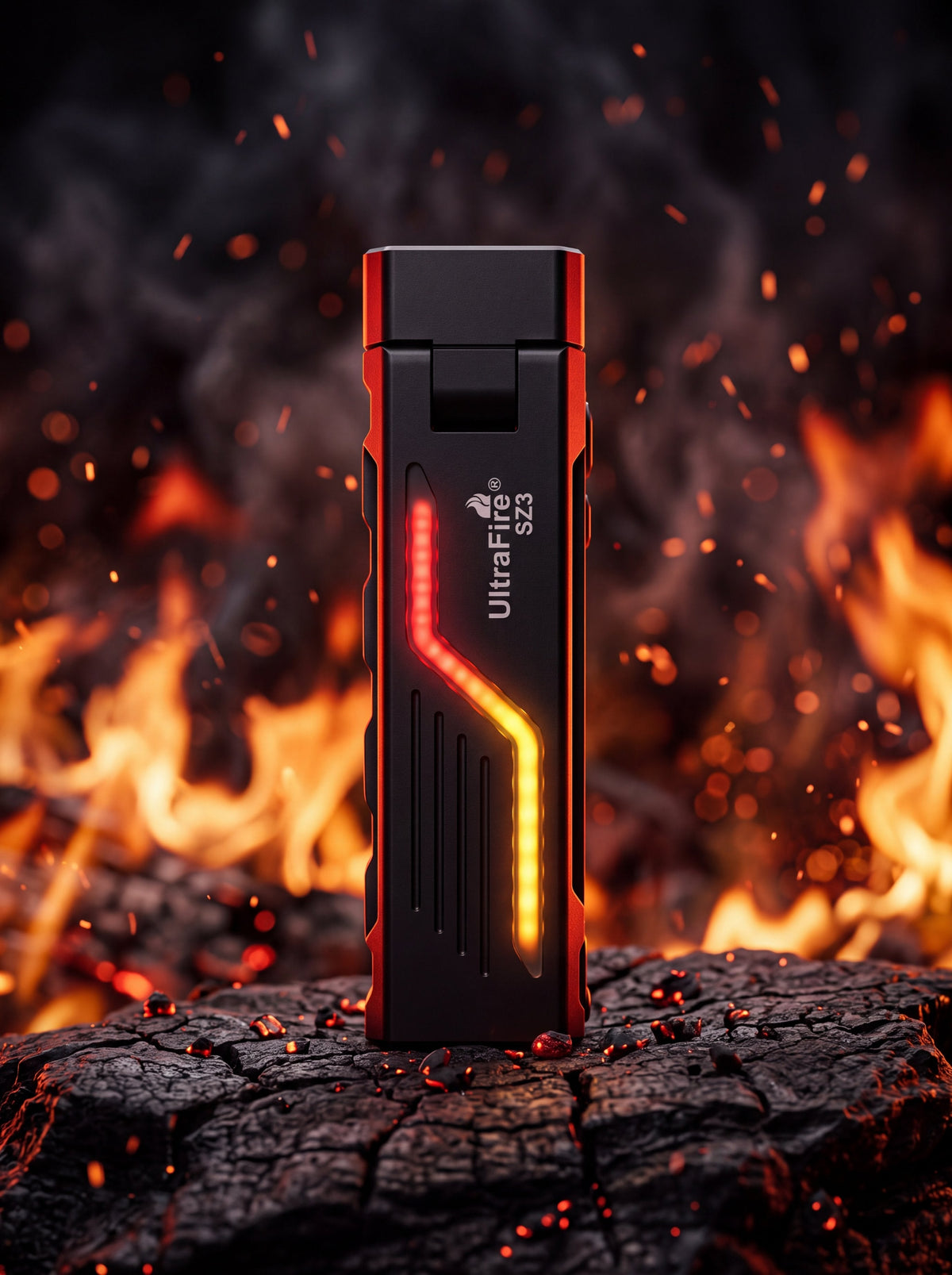
UltraFire SZ3 Swivel Head EDC Flashlight | 1300LM CRI90+
A flat EDC light for hands-free work in bad weather: aim the swivel head at the job, stick the magnetic tail to anything metal, and keep both hands free while rain does its worst.
- 1,300 lumens, high-CRI 90+ for true colors
- 0–100° swivel head with spot + flood dual beams
- Magnetic tail for hands-free mounting
- 1,500 mAh battery, USB-C charging (works while charging on low)
- IPX6 water resistance, 1-meter drop resistance, 3-year warranty
- $55.99

UltraFire UF-303X Rechargeable Traffic Wand
One light, two jobs: a dependable flashlight for seeing, and a detachable signal tube that turns it into a traffic wand for directing vehicles and staying visible on a dark, wet roadside.
- 2-in-1 design: flashlight + detachable signal tube
- USB-C rechargeable — no spare batteries to hunt for
- IPX6 water resistance for storm conditions
- $27.99
Your IP Rating Checklist: Keep the Seals Working
A rating describes how a light was built and tested. Keeping that protection working is mostly a matter of small habits:
- Close every cover fully. Before heading into rain, check that the USB charging cover, battery cover, and any tailcap are seated and closed. An open cover bypasses the rating entirely.
- Inspect O-rings and seals. Look for cracks, flattening, grit, or a seal that has slipped out of its groove. Clean grit off with a dry cloth and replace a damaged seal before trusting the light in water again.
- Dry before you open or charge. Wipe the light dry, and make sure the charging port is dry, before plugging in a USB-C cable or opening a cover. Water trapped inside a port can cause corrosion even if the light itself keeps working.
- Rinse after salt, mud, or sand. A quick rinse with clean fresh water, followed by drying, removes the residues that wear seals down. Do this after beach, roadside, or job-site use.
- Check after a hard drop. If a light takes a hard fall onto concrete, inspect the lens, bezel, and covers before the next wet use. Impact damage is the most common way a rated seal stops sealing.
- Store dry, with covers closed. Long storage in a damp bag or toolbox invites corrosion. Store lights dry, at room temperature, and top up rechargeable lights periodically following the manufacturer’s guidance.
- Read the specification, not just the code. For any IPX8 light, note the rated depth and time. For any light, note whether dust was rated at all — IPX6 and IP6X are different claims.
- Never charge a wet light. Dry the body and the charging port completely before connecting a cable, and do not charge a light that has been damaged, dented, or dropped hard.
- Do not open covers in the rain. Opening a battery or USB cover while water is running over the light lets water straight past the seals the rating depends on.
- Do not rely on a rating after damage. A cracked lens, a bent bezel, or a torn seal voids the protection the rating describes, even if the light still turns on.
- Stay within the rated depth and time. An immersion rating is a tested limit, not a challenge. Exceeding it — deeper, longer, or in moving water — is how lights flood.
- Keep beams out of eyes. A high-output light can cause discomfort and temporary vision effects. Never shine a flashlight directly at people, drivers, or animals.
Final Thoughts
IP codes are worth learning because they replace guesswork with a test you can compare. Decode the two digits, check whether an X is hiding an untested claim, and match the test to the water and dust your light will actually meet. For most outdoor and work use, IPX6 covers the worst rain you are likely to stand in; IP68 earns its place when dust and deeper water are part of the job. Either way, the rating only holds as long as the seals do — close the covers, dry the port before charging, and inspect the light after a hard knock.
Ready to pick a light for wet weather? Start with the SZ3 for hands-free work, or the UF-303X for roadside visibility, and browse the full lineup in the UltraFire collection.