
An 18650 measures 18 × 65 mm, a 21700 measures 21 × 70 mm, and an 18350 measures 18 × 35 mm. All three are normally 3.7-volt lithium-ion cells, so voltage does not make them interchangeable — size does. Always buy the exact size your flashlight was built for, and check whether it needs a protected, button-top cell.
- The five-digit name is a size code: diameter in millimetres, length in millimetres, and 0 for a cylindrical cell. It says nothing about capacity on its own.
- A 21700 will not fit a light built for an 18650. Going the other way — an 18650 in a 21700 light — only works with a sleeve made for that conversion, and you give up runtime.
- Protected cells carry a small circuit board and run a few millimetres longer than the bare size name. Button-top and flat-top describe the positive end, and the wrong end shape may not make contact.
- Capacity ranges are typical values that vary by maker and model. A listing that claims far more than about 3,600 mAh for an 18650 should not be trusted.
How to Read the Numbers: 18650, 21700, and 18350
A cylindrical lithium-ion cell is named for its physical size. Read the five digits as three parts:
- First two digits — diameter in millimetres. An 18650 is about 18 mm across; a 21700 is about 21 mm across; an 18350 is about 18 mm across.
- Next two digits — length in millimetres. An 18650 is about 65 mm long; a 21700 is about 70 mm long; an 18350 is about 35 mm long — 30 mm shorter than an 18650, at the same diameter.
- Final 0 — cylindrical shape. It does not mean capacity, voltage, or quality.
That is the nominal size — the size the cell is named for. The cell you hold can measure a little larger. A cell with a built-in protection circuit carries a small circuit board, usually at one end, and the extra board and wrapping add length: a protected 18650 is often around 68–70 mm long instead of 65 mm, and one maker's published dimensions put a protected 21700 at 21.5 × 76 mm instead of 21 × 70 mm. Exact figures vary by maker, which is why a flashlight is built around a real cell length, not just the size name. When a product page lists a battery size, it means the size that actually fits that light — including its protection and end shape, if the page specifies them.
All three sizes share the same electrical starting point. A standard lithium-ion cell of this family has a nominal voltage of 3.6 or 3.7 volts and reaches about 4.2 volts when fully charged. (Some chemistries differ — lithium iron phosphate cells, for example, run at about 3.2 volts nominal — but the 18650, 21700, and 18350 cells sold for flashlights are normally the 3.7-volt type.) Because the voltage is the same, voltage alone never decides whether a cell fits or works in a light. Size, length, end shape, and current delivery decide that.
Why a Bigger Cell Holds More Energy: Volume and Watt-Hours
Capacity, measured in milliamp-hours (mAh), tells you how much charge a cell holds. Energy, measured in watt-hours (Wh), tells you how much work that charge can do at the cell's voltage. The two are linked by a simple calculation:
Energy (Wh) = capacity (Ah) × nominal voltage (V). For a 3.7-volt cell, a 3,500 mAh cell holds 3.5 × 3.7 = 12.95 Wh, and a 5,000 mAh cell holds 5.0 × 3.7 = 18.5 Wh.
A larger cell holds more because there is physically more room inside it for the materials that store energy. A cylinder's volume is V = π × r² × h, where r is half the diameter and h is the length:
- 18650: π × 9² × 65 ≈ 16,541 mm³
- 21700: π × 10.5² × 70 ≈ 24,245 mm³
- 18350: π × 9² × 35 ≈ 8,906 mm³
The 21700 has about 47% more internal volume than the 18650 ((24,245 − 16,541) ÷ 16,541 ≈ 0.47), from only 3 mm more diameter and 5 mm more length. That extra volume is why typical 21700 capacities run higher — but only by roughly 30–50%, not by double, because the casing, separator, and safety parts also take up space. The 18350, at about 54% of the 18650's volume, holds roughly a third of the energy: a typical 1,200 mAh 18350 holds 1.2 × 3.7 = 4.44 Wh, against 12.95 Wh for a 3,500 mAh 18650. At the same brightness setting, runtime scales roughly with energy, so the larger cell runs longer — and a light that steps down from its highest mode does so on its own thermal and voltage limits, not because the cell changed size. For how those runtime figures are measured, see our ANSI FL1 guide to reading flashlight specs.
18650 vs. 21700 vs. 18350: Side by Side
| Cell | Nominal size | Typical capacity | Energy at 3.7 V | Suited to |
|---|---|---|---|---|
| 18350 | 18 × 35 mm | 700–1,200 mAh | 2.6–4.4 Wh | Compact lights where a short body matters more than runtime |
| 18650 | 18 × 65 mm | 2,500–3,500 mAh (about 3,600 mAh at most) | 9.3–13.0 Wh | Full-size EDC and general-purpose lights; the most widely used size |
| 21700 | 21 × 70 mm | 4,000–5,000 mAh | 14.8–18.5 Wh | Newer, larger lights where longer runtime and higher output matter |
These capacity ranges are typical values across makers, not a specification for any single cell. Two cells with the same size name can hold different amounts of energy, deliver different maximum currents, and behave differently at high output. Always read the individual cell's label and the flashlight maker's listing, rather than assuming every 18650 — or every 21700 — performs alike.
Can You Swap One Size for Another?
Short version: only in one direction, only with the right sleeve, and only when the light's maker says so. Each case below follows from the physical sizes above.
A 21700 in a light built for 18650: no
The 21700 is 3 mm wider and 5 mm longer than the 18650. A battery tube machined for an 18 mm cell cannot accept a 21 mm cell, and a tube cut for 65 mm cannot close over a 70 mm cell. Forcing it risks damaging the cell wrapper, the light's contacts, or both. If the cell does not slide in easily and let the cap close without force, it is the wrong size.
An 18650 in a light built for 21700: sometimes, with a maker-supplied sleeve
An 18650 is smaller in both directions, so it fits loosely in a 21700 tube. Some lights are sold with, or accept, a sleeve (adapter tube) that takes up the 3 mm of diameter and 5 mm of length so the smaller cell sits centred and makes firm contact at both ends. Use only a sleeve made for that conversion and confirmed for that light. Without one, the cell can rattle, lose contact, and flicker or cut out. Even with a sleeve, expect shorter runtime in proportion to the smaller cell's capacity, and on some high-output lights the smaller cell may not sustain the highest mode the same way — the adapter changes the fit, not the cell's own current capability.
An 18350 in a light built for 18650: no, unless the light was designed for it
The 18350 shares the 18650's 18 mm diameter but is 30 mm shorter, so in a normal 18650 tube it cannot reach both contacts at once. A few compact lights are sold to run on a short tube or with a maker-supplied spacer for exactly this reason. Outside such a design, do not improvise spacers, padding, tape, foil, or magnets to bridge the gap — improvised fillers can shift, break contact, or create a short. The same rule covers every direction: never improvise an adapter, and never modify a cell or a light to make a size fit.
Mixing sizes, brands, or charge levels in multi-cell lights
This guide covers single-cell lights, which is how most EDC and UV flashlights in this size range are built. Lights that take two or more cells in series or parallel add matching requirements of their own. If your light takes more than one cell, follow its manual exactly and do not mix sizes, brands, capacities, or cells at different charge levels.
Protected vs. Unprotected, Button-Top vs. Flat-Top
Two further labels decide fit, and neither appears in the five-digit size name.
Protected vs. unprotected
A protected cell has a small protection circuit built into the cell — usually a circuit board under the wrapper at one end — that cuts off the cell if it is over-charged, over-discharged, or shorted. An unprotected cell has no such circuit in the cell itself and relies on the device's own protection, if the device has any. Protection is a safety margin, not a performance feature: it does not add capacity, and it adds length, as the dimensions above show. Some modern flashlights have their own low-voltage protection in the driver, so they can run unprotected cells safely; others are built around protected cells. The manual or product page is the authority for a given light — do not guess from the size name alone.
Button-top vs. flat-top
Button-top means the positive end has a small raised nub, like the positive terminal of an AA battery. Flat-top means the positive end is flat. Which one a light needs depends on its contacts: a light with a flat contact plate or a recessed spring may need the raised nub to reach it, while a light with a protruding spring contact may accept either. A flat-top cell in a light built for button-top cells can fail to make contact at all, or make contact only intermittently. Check the listing before buying — if it says button-top, buy button-top; if it says flat-top, buy flat-top; if it says neither, ask the seller or check the manual rather than assuming.
Put together, a complete battery specification has four parts: size (18650, 21700, or 18350), protection (protected or unprotected), end shape (button-top or flat-top), and the cell's own capacity and current rating. Buying on size alone is how most mismatches happen.
How to Buy the Right Cell: A Short Checklist
- Start from the light, not the battery. Read the manual or product page for the exact cell size, and whether it calls for a protected cell, a button-top cell, or both. If the light has a built-in battery that is not designed to be replaced by the user, no loose cell applies — see the SZ3 example below.
- Match capacity to how you use the light. A 21700 light earns its size on long runtimes and frequent high-output use; an 18650 suits a pocket light you carry daily; an 18350 suits a short light where size matters most and you accept charging more often.
- Buy from a reputable seller and read the label. Compare the claimed capacity with the typical ranges in the table above. Claims far above about 3,600 mAh for an 18650 exceed what the size can physically hold with current chemistry, and should not be trusted.
- Check the fit before you rely on it. The cell should slide in without force, sit without rattling, and let the tail cap or battery cover close fully. If anything needs force, stop — the cell, sleeve, or end shape is wrong for that light.
- Inspect the cell. Do not use a cell with a torn wrapper, a dented body, or visible damage, and keep loose cells where their terminals cannot touch keys, coins, or other metal. Store spare cells at a partial charge in a cool, dry place, in a case made for the purpose.
- Never force a cell into a tube, and never close a cap against resistance.
- Never improvise adapters, spacers, or padding, and never modify a cell or a light to make a size fit.
- Never mix sizes, brands, capacities, or charge levels in a multi-cell light.
- If a light flickers, cuts out, or runs hot with a new cell, remove the cell and re-check size, protection, and end shape before using the light again.
Two UltraFire Examples: One Takes a 21700, One Takes No Cell at All
Not every UltraFire light uses a loose cell. The two lights below show both cases: the RUV3 runs on a removable 21700, while the SZ3 runs on a built-in battery that is not designed to be swapped by the user. Knowing which kind you own decides whether this guide's battery sizes apply to you at all.

UltraFire RUV3 365nm UV Flashlight | 10W, ZWB2 Filter
A 21700-powered UV light: true 365nm output through a ZWB2 filter, with a removable 21700 battery included and USB-C charging. The larger cell suits long inspection sessions — mineral checks, resin curing checks, and scorpion searches — where runtime matters.
- True 365nm UV, 10W, ZWB2 filter
- Removable 21700 battery included; USB-C charging
- Dual modes, 4.5-hour runtime (maker figure)
- $49.99

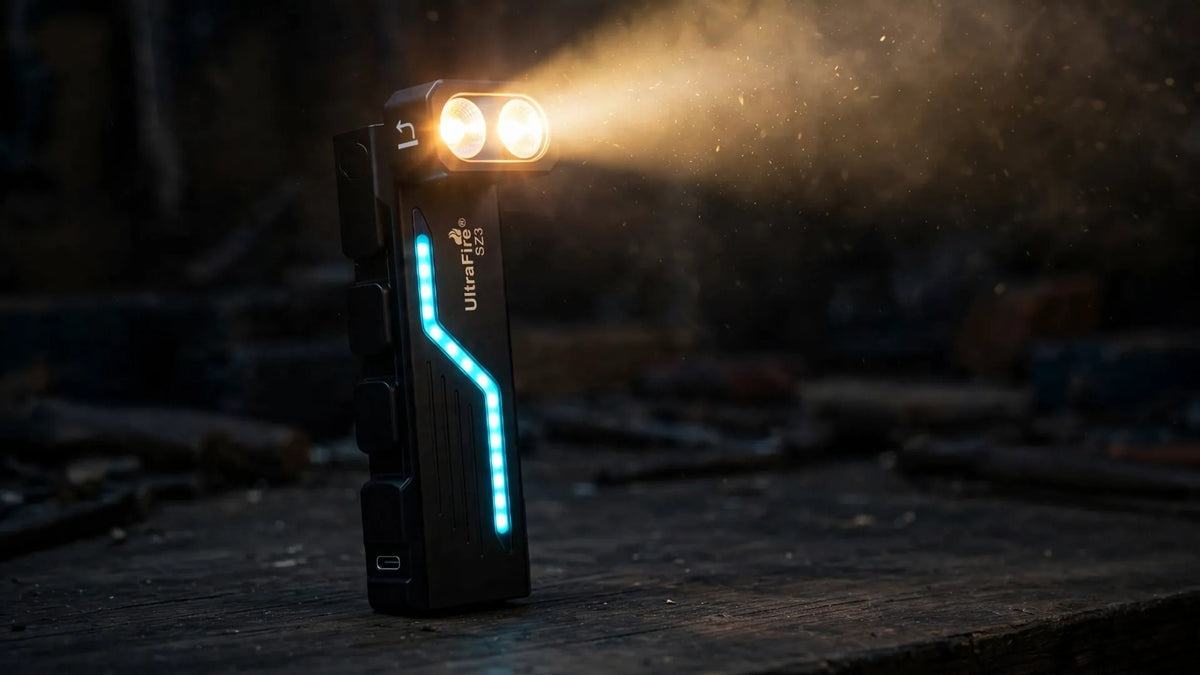
UltraFire SZ3 Swivel Head EDC Flashlight | 1300LM CRI90+
Built-in battery, no loose cell to buy: the SZ3 charges by USB-C and runs on its own 1,500 mAh battery, which is not designed to be replaced by the user. If you own an SZ3, none of the 18650, 21700, or 18350 sizes in this guide apply to it.
- 1,300 lumens, high-CRI 90+ for true colors
- Built-in 1,500 mAh battery, USB-C charging (works while charging on low)
- 0–100° swivel head with spot + flood dual beams; magnetic tail
- IPX6 waterproof, 1-meter drop resistance, 3-year warranty
- $55.99
Frequently Asked Questions
Can I use a 21700 battery instead of an 18650?
No. A 21700 is 21 mm wide and 70 mm long, against 18 × 65 mm for an 18650, so it will not fit a battery tube built for an 18650. Forcing it can damage the cell wrapper and the light's contacts. Use only the size the light was built for.
Can I use an 18650 battery in a flashlight made for 21700?
Sometimes, and only with a sleeve made for that conversion and confirmed for that light. The sleeve centres the smaller cell so it makes firm contact. Expect shorter runtime, in proportion to the 18650's smaller capacity, and check that the light still holds its highest mode. Without a sleeve, the cell rattles and can lose contact.
What does 18650 mean?
It is a size code, not a model name: 18 mm in diameter, 65 mm long, and 0 for a cylindrical cell. The same code reads 21 × 70 mm for a 21700 and 18 × 35 mm for an 18350. The name says nothing about capacity, voltage, or quality — those come from the individual cell's label.
Do 18650 and 21700 batteries have the same voltage?
Yes, normally. Both are standard 3.7-volt nominal lithium-ion cells (about 4.2 volts fully charged). The difference is physical size and the energy that size allows: a typical 21700 holds 14.8–18.5 Wh against 9.3–13.0 Wh for a typical 18650. Shared voltage does not make them interchangeable.
Protected or unprotected — which does my flashlight need?
Whichever its manual or product page specifies. A protected cell adds a circuit that cuts off on over-charge, over-discharge, or a short, and it runs a few millimetres longer than the bare size name. Some lights have their own low-voltage protection and can use unprotected cells; others are built around protected cells. Check the listing for both protection and button-top or flat-top before buying.
Final Thoughts
18650, 21700, and 18350 look alike at a glance — same voltage, same cylindrical shape, similar names. The differences that matter are all physical: 3 mm of diameter here, 30 mm of length there, a circuit board that adds a few millimetres, a raised nub that decides whether the cell touches at all. Read the size code, read the whole specification, and buy the cell your light was actually built for. That one habit prevents nearly every battery mismatch: a cell that fits without force, contacts firmly, and runs as long as its watt-hours promise.
Still unsure which size your light takes? Check the manual or product page first — and if your light is a built-in-battery model like the SZ3, you need no loose cell at all. For a 21700-powered UV light, see the RUV3.