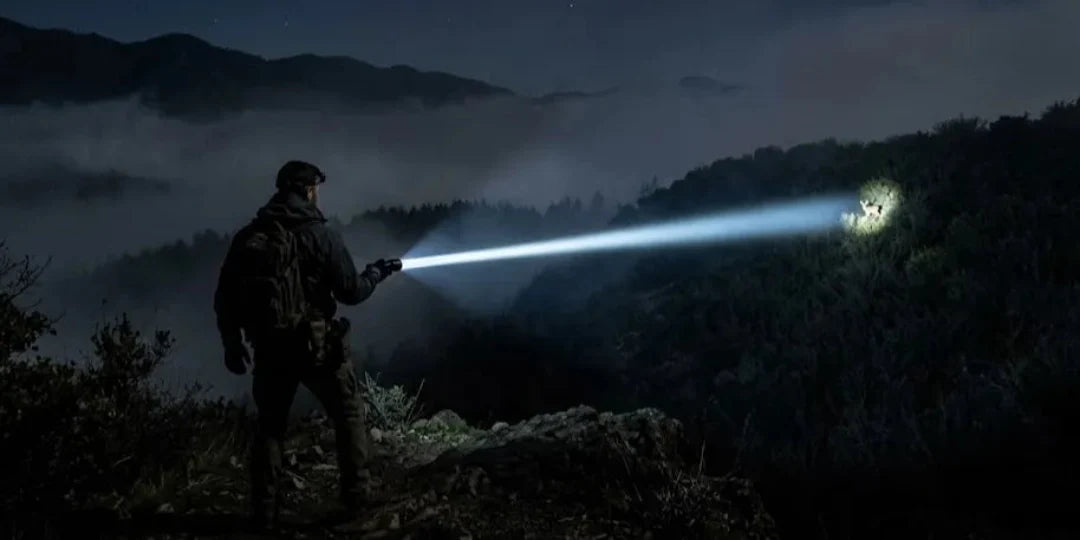

Fall is the sweet spot for the outdoors. Campgrounds in national and state parks hit their busiest stretch, the air turns cool and crisp, and the sun sets early. That last part is a gift if you love rockhounding. Earlier darkness means more hours when a UV flashlight can reveal glowing rocks that are invisible in daylight. This guide covers how to plan a fall camping trip with night rockhounding in mind, why 365 nm is the wavelength to choose, and how the UltraFire RUV3 and C15S fit different styles of hunting.
- Early sunsets and cool, often dry fall nights make autumn a prime season for camping and night rockhounding.
- 365 nm is the preferred UV wavelength for fluorescent minerals because it produces little visible light, so glowing rocks stand out with high contrast.
- UltraFire RUV3: 10W, ZWB2-filtered 365 nm light, ideal for close-up inspection of specimens, tables, and small areas.
- UltraFire C15S: 16W, ZWB2-filtered 365 nm light with a deep reflector, ideal for scanning wider areas and reaching farther.
Why Fall Is the Best Season for Camping and Night Rockhounding
Fall brings a combination of conditions that is hard to beat.
- Comfortable temperatures. Cool days are great for hiking and long walks along shorelines, trails, and gravel bars. Cool nights make a campfire welcome rather than a chore.
- Earlier darkness. You don't need to stay up until midnight to start UV hunting. In autumn, it gets dark early enough to hunt after dinner and still get a full night's sleep.
- Drier, clearer conditions in many regions. Less rain and haze make it easier to move around and spot fluorescent finds.
- Fewer bugs. Cooler nights mean fewer mosquitoes and biting insects, so you can hunt in comfort.
- Great destinations. From Great Lakes shorelines, where hunters search for fluorescent sodalite-bearing rocks often nicknamed Yooperlites, to mining districts across the Southwest, many classic rockhounding regions are at their best in fall.
Your Fall Camping Checklist, With Night Hunting in Mind
Before you head out, make sure the basics are covered. Check the forecast and the regulations for your destination, then pack for cold nights.
- Shelter and sleep: A tent rated for cool weather, a sleeping bag with a suitable temperature rating, and an insulated sleeping pad
- Layers: Moisture-wicking base layers, an insulating mid layer, and a windproof, waterproof shell
- Footwear: Waterproof boots with good traction, plus dry socks
- Camp cooking and water: A stove, fuel, a water filter or enough water for the trip, and warm food
- Navigation and safety: A map and compass or offline maps, a first aid kit, and a plan you've shared with someone at home
- White light: A headlamp for camp chores and for walking safely over uneven ground
- UV light: Your night rockhounding tool, covered in detail below
- Power: Spare charged batteries and a power bank or charging cable
How Night Rockhounding Works
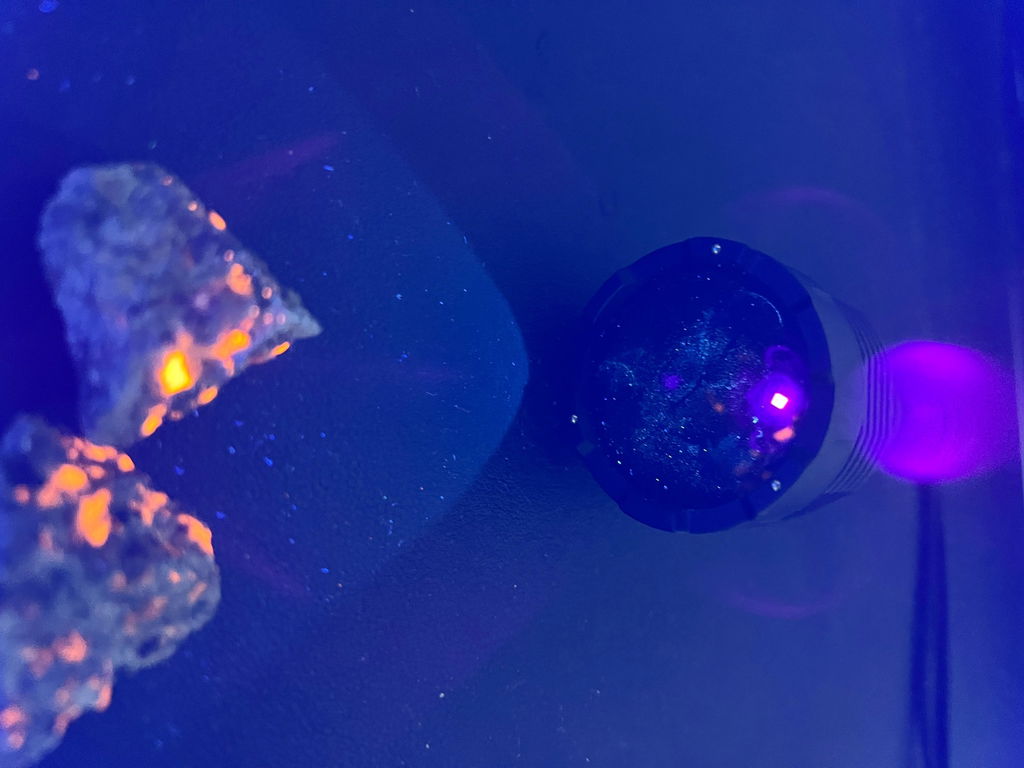
Many minerals contain trace elements that absorb ultraviolet light and re-emit it as visible color. This is called fluorescence. Under normal light, a fluorescent rock can look like any other gray or brown stone. Shine the right UV wavelength on it in the dark, and it can light up in vivid orange, yellow, red, green, or blue.
That is why rockhounds hunt at night. Daylight and ambient light wash out the glow, while a dark beach, trail, or camp table lets even faint fluorescence show clearly.
Why 365 nm Is the Wavelength to Choose
UV flashlights are sold in several wavelengths, but 365 nm is the favorite for longwave mineral hunting. A 365 nm light emits very little visible light, so there is less purple haze to wash out the colors you are trying to see. Many minerals, including fluorite, certain calcites, and the sodalite-bearing rocks that hunters search for around the Great Lakes, respond well to longwave UV.
Lower-cost 395 nm lights also give off a visible violet glow. It makes them easy to use for everyday jobs, but that extra glow competes with the fluorescence you want to see.
Why a Filter Makes a Visible Difference
Even a good 365 nm LED leaks some visible light. A ZWB2 filter is a black glass lens that lets UV through while blocking most visible light. The result is a darker background and a stronger contrast between the glowing rock and everything around it. Both the RUV3 and the C15S use a ZWB2 filter for this reason.

UltraFire RUV3: Precision for Close-Up Inspection
The RUV3 is a compact 10W, true 365 nm flashlight designed around purity. Its ZWB2 filter blocks 99% of visible light above 400 nm, so what you see is the rock's own glow, not the flashlight's.


UltraFire RUV3 365 nm UV with ZWB2 Filter | 10W Dual-Mode Detection Tool
The RUV3 is the tool to reach for when you want to study a rock up close: sorting a bucket of finds at camp, scanning a table of specimens, or checking a stone's glow before you decide to keep it.
- 10W output, true 365 nm (UVA) with 562.8 mW radiant flux at the lens
- ZWB2 filter blocks 99% of visible light above 400 nm
- Dual modes (High and Low) with about 4.5 hours of runtime
- 21700 5000 mAh battery and USB-C charging cable included
- Hard-anodized aluminum (T6061) body, IP65 waterproof
- 6.42 in (163 mm) long; 5.03 oz
- UV protective glasses included
Why rockhounds like it: Low mode is gentle on close-up work and helps save battery between finds, while High mode gives you the power to push across a wider patch of ground. USB-C charging means you can top it off at camp from a power bank or your vehicle.
UltraFire C15S: Reach and Coverage for Wider Areas
If the RUV3 is the precision tool, the C15S is the scanner. A 16W 365 nm emitter sits behind a deep reflector, which gives the beam long throw. That lets you sweep a shoreline, gravel pit, or trail edge and pick out glowing stones from farther away, with less bending over and walking in circles.

UltraFire C15S 365 nm UV Flashlight | 16W
A powerful, field-ready 365 nm flashlight with a ZWB2 filter for high-contrast fluorescence and a deep reflector for distance. It is a strong match for beaches, trails, and open ground where you want to cover more area.
- 16W 365 nm emitter with a ZWB2 filter
- Deep reflector, machined cooling fins, and constant-current delivery
- USB-C charging; 18650 2600 mAh battery and cable included
- Aircraft-grade aluminum body with a steel ball strike bezel
- 5.98 in (152 mm) long; 1.75 in (44.5 mm) head diameter
RUV3 vs. C15S: Which One Is Right for You?
| Feature | RUV3 | C15S |
|---|---|---|
| Wavelength | 365 nm | 365 nm |
| Power | 10W | 16W |
| Filter | ZWB2 | ZWB2 |
| Best for | Close-up inspection, sorting finds, specimen tables | Scanning wide areas and reaching farther |
| Battery included | 21700 5000 mAh | 18650 2600 mAh |
| Charging | USB-C | USB-C |
| Length | 6.42 in (163 mm) | 5.98 in (152 mm) |
| Extras | Dual modes; UV protective glasses included | Steel ball strike bezel |
Choose the RUV3 if you spend most of your time examining rocks up close, sorting finds around camp, or want the longer runtime of its larger battery and a Low mode for careful work.
Choose the C15S if you cover a lot of ground, like shorelines, gravel bars, and open trails, and want a beam that reaches out and lights up a wider area.
Many rockhounds carry both: the C15S to find, the RUV3 to inspect. And if you later want to explore minerals that respond to shortwave or midwave UV, browse the UltraFire UV Flashlight Collection.
Night Rockhounding Pack List
- Your UV flashlight (RUV3 or C15S) and a spare charged battery
- UV-blocking glasses
- A headlamp, so you can see the ground when the UV light is off
- Small bags or containers for finds, and a notebook for locations
- Gloves, water, and warm layers
- A power bank and USB-C cable
- A map, and a way to call for help
Cold-Weather Battery Tips
Lithium-ion batteries lose capacity in the cold. On chilly fall nights, keep your spare battery in an inside pocket close to your body, and swap it in if your light starts to dim. Charge everything fully before you leave camp.
- Protect your eyes. Never look into a UV beam or shine it at anyone, and wear UV-blocking glasses. The RUV3 includes a pair.
- Mind your footing. UV light makes it hard to judge terrain. Use a white headlamp when walking over rocks, slopes, or shoreline.
- Check collecting rules. Rules on removing rocks and minerals vary widely. Many national parks and some state parks prohibit collecting, some public lands allow limited casual collecting, and private land requires the owner's permission. Stay off active mining claims, and check with the land manager before you go.
- Leave no trace. Pack out all trash, don't dig into banks or damage vegetation, and leave the area as you found it.
- Tell someone your plan. Share your location and expected return time, especially when hunting alone at night.
Final Thoughts
Fall gives you comfortable weather, early darkness, and some of the best conditions of the year for finding fluorescent rocks. Pair a well-planned camping trip with a quality 365 nm light and you can turn an ordinary night walk into a treasure hunt. Whether you choose the RUV3 for careful close-up work or the C15S for wide-area scanning, a filtered 365 nm beam helps the colors stand out.
Ready to light up your next trip? Explore the full lineup in the UltraFire UV Flashlight Collection.