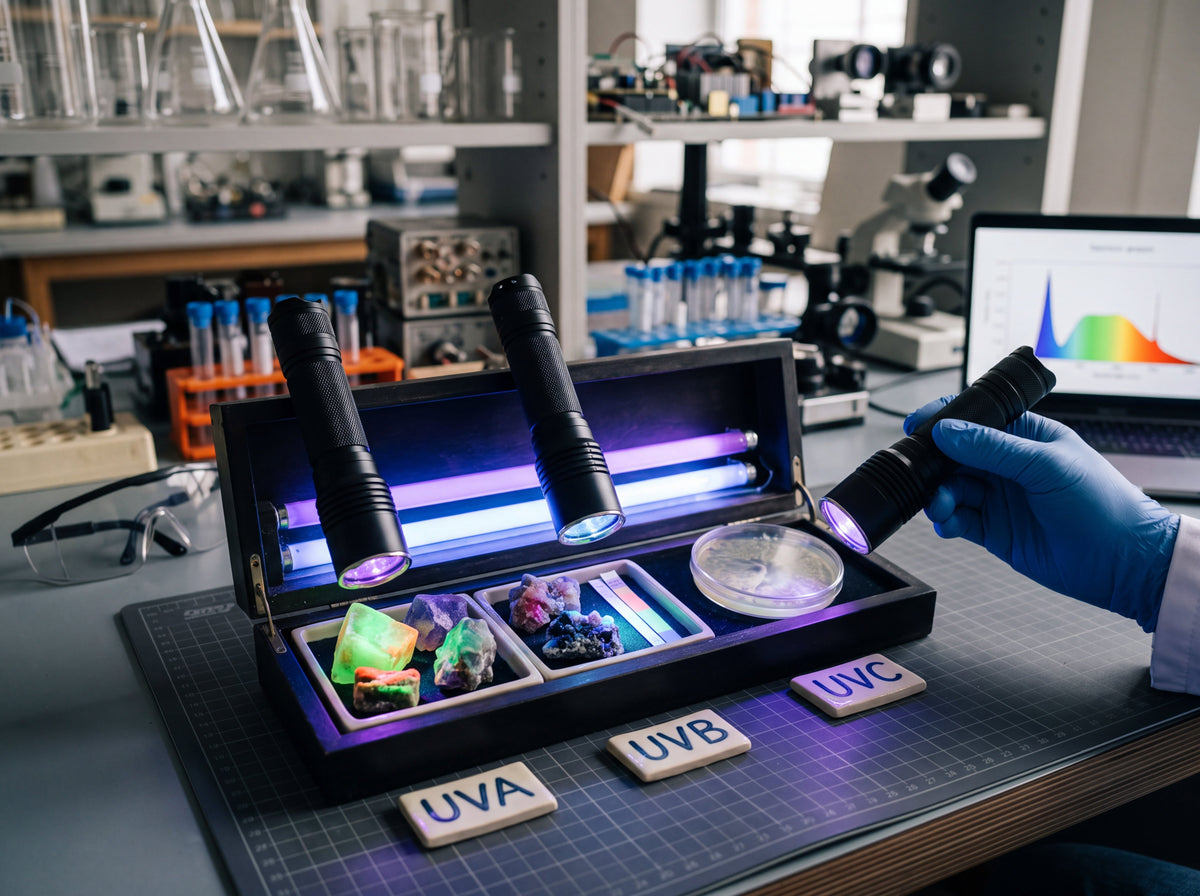

Ultraviolet (UV) radiation occupies the invisible boundary of the electromagnetic spectrum just beyond human vision. While standard illumination tools aim to flood an area with broad-spectrum visible lumens, a high-performance blacklight flashlight operates on an entirely different optical principle: converting invisible ultraviolet radiation into vivid, visible luminescence through Stokes shift excitation.
For years, the commercial market was saturated with longwave 395nm diodes that produced excessive purple visible light spill, obscuring faint fluorescent reactions. The emergence of precision-engineered 365nm uv flashlight systems has transformed field mineralogy, non-destructive testing (NDT), forensic tracing, and home inspection.
Whether you are scouring coastal shorelines for fluorescent sodalite or locating elusive micro-leaks in an HVAC system, selecting the best uv flashlight requires understanding wavelength physics, optical filtration, and optoelectronic engineering.
1. The Physics of Ultraviolet Light: 365nm vs. 395nm
When evaluating a UV light source, wavelength determines the efficiency of fluorescence excitation and the purity of the visual output.
+-------------------------------------------------------------------------------+
| Spectrum:     [ Far / Mid UV ]  <--- UV-A (315–400nm) --->  [ Visible Spectrum ]|
| Wavelengths:       254nm              365nm        395nm          400nm+      |
| Visual Output:   Invisible         Pure Dark     Purple Glare   Visible Violet|
+-------------------------------------------------------------------------------+
The Electromagnetic Spectrum & Visible Light Spill
Human daylight vision (photopic response) is sensitive to wavelengths between approximately $380\text{ nm}$ and $750\text{ nm}$, peaking around $555\text{ nm}$.
-
395nm UV Emitters: Sit directly on the edge of human vision. Because LED emission spectra follow a bell curve (spectral bandwidth of $\approx \pm 10\text{--}15\text{ nm}$), a 395nm diode casts a substantial amount of visible violet and purple light ($400\text{--}420\text{ nm}$) over target objects.
-
365nm UV Emitters: Emit deep in the UV-A band. The primary output is virtually invisible to the naked eye, projecting a soft, muted beam until it strikes a fluorescent substance.
Signal-to-Noise Ratio and Fluorescence Contrast
Fluorescence occurs when electrons absorb high-energy UV photons, jump to an excited state, and emit lower-energy photons in the visible spectrum as they return to ground state.
-
With 395nm: The intense visible violet glare reflects back into the user’s eyes, overpowering weak fluorescence. The signal-to-noise ratio is poor.
-
With 365nm: The absence of ambient visible glare creates an ink-black background. Target minerals, organic compounds, and inspection dyes stand out in razor-sharp, high-contrast glow.
2. The Optical Standard: Why Filtered Black Optical Glass Matters
A common misconception is that a 365nm LED emitter alone guarantees a pure blacklight beam. In practice, raw LED dies generate a small amount of residual white/yellow visible light across their semiconductor substrates.
[ Raw 365nm LED ] ---> [ UV Energy + Residual Visible Light Spill ]
                                       |
                                       v
                           [ ZWB2 Wood's Glass Filter ]
                                       |
                                       v
                           [ Pure, Filtered 365nm Beam (Zero Visible Spill) ]
The Function of ZWB2 (Wood’s Glass) Filters
To achieve true optical purity, premium UV tools incorporate a specialized ZWB2 black optical bandpass filter (the modern standard for Wood's glass).
-
Bandpass Transmission: High-grade ZWB2 glass permits peak transmission at $365\text{ nm}$ while blocking visible wavelengths between $400\text{ nm}$ and $700\text{ nm}$.
-
Elimination of "Ghost Glare": Without this filter, white light bleed reflects off pale rocks, white fabrics, and glossy surfaces, washing out delicate color differences.
-
Contrast Maximization: A filtered 365nm light transforms faint mineral veins or micro-cracks into distinct, luminous features against an unlit backdrop.
3. Real-World Applications for 365nm UV Systems
Fluorescent Mineral Hunting & Rockhounding
Field prospecting at night requires pure optical output. Mineral collectors and rockhounds rely on longwave 365nm light to reveal vivid mineral compositions:
-
Yooperlites (Fluorescent Sodalite in Syenite): Emits a fiery orange-yellow glow under filtered 365nm light, found along Lake Superior's rocky shores and glacial drift areas.
-
Calcite & Aragonite: Display intense red, orange, white, or pink fluorescence depending on activator impurities like manganese.
-
Willemite & Fluorite: Willemite fluoresces an unmistakable electric green, while fluorite yields classic deep violet-blue tones.
-
Autunite & Uranium Minerals: Emit bright neon-green luminescence under longwave excitation.
+-------------------+----------------------------+-----------------------------+
| Mineral Type      | Primary Chemical Activator | Typical Fluorescence Color  |
+-------------------+----------------------------+-----------------------------+
| Sodalite / Yooper | Disulfide (S₂⁻) Ions       | Intense Orange / Yellow     |
| Calcite           | Manganese (Mn²⁺)           | Fiery Orange-Red / Pink     |
| Willemite         | Manganese (Mn²⁺)           | Neon Electric Green         |
| Fluorite          | Europium / Rare Earths     | Royal Blue / Violet         |
+-------------------+----------------------------+-----------------------------+
Pet Stain & Organic Residue Detection
Proteins, salts, phosphorus, and dried urine salts (such as urobilin and porphyrins) naturally fluoresce under 365nm UV. A filtered blacklight illuminates localized bio-stains on carpet, hardwood, and upholstery without blinding reflections.
UV Resin Curing & Optical Adhesives
Industrial and crafting UV adhesives, fly-tying resins, and optical cements are formulated with photoinitiators calibrated to cross-link around the $365\text{ nm}$ spectrum. 365nm UV light provides deeper, faster penetration into transparent polymers without leaving an uncured, tacky surface layer.
HVAC & Automotive AC Leak Detection
Technicians inject fluorescent dyes into closed refrigerant, engine oil, or cooling systems. When illuminated by a 365nm beam, micro-fissures, failing compressor seals, and O-ring leaks fluoresce with intense neon brilliance, even under ambient shop lighting.
4. Key Engineering Factors: What Defines a Professional UV Flashlight?
Building a dependable UV tool requires distinct design choices compared to standard white-light flashlights.
-
Epitaxial LED Quality: High-radiant-flux UV-A diodes (delivering pure mW optical output rather than misleading lumens) ensure strong excitation at distance.
-
Direct Thermal Path (DTP) Copper MCPCBs: UV LEDs convert a substantial portion of electrical input into heat rather than visible light. Premium thermal management with copper circuit boards prevents thermal throttling and spectral shift.
-
CNC-Machined Aerospace Aluminum Housing: Hard-anodized aluminum (Type III hard-coat) ensures structural rigidity, IPX-6 or IPX-8 water resistance, and drop protection during rigorous outdoor expeditions.
-
Constant-Current Regulation: Solid-state drivers maintain flat, consistent UV output throughout the battery discharge curve, preventing gradual dimming during field searches.
-
High-Drain Lithium-Ion Power: Operating on rechargeable 18650 or 21700 lithium-ion cells ensures high radiant output and extended runtimes.
5. Buying Criteria: Choosing the Right UV Setup
When searching for the best uv flashlight, evaluate options based on your specific operational environment:
+-----------------------------------------------------------------------------------+
| Feature Matrix: What to Prioritize by Use Case                                   |
+----------------------+--------------------+-------------------+-------------------+
| Application          | Optical Filter     | Form Factor       | Power Source      |
+----------------------+--------------------+-------------------+-------------------+
| Mineral Hunting      | ZWB2 Filter (Req.) | Medium / Deep Ref | High-Drain 18650  |
| HVAC / Mechanics     | Filter Preferred   | Compact EDC       | USB-C Integrated  |
| Resin Curing         | Open / Filtered    | Pocket / Spot     | 18650 / 14500     |
| Home Inspection      | Filter Preferred   | Flood Beam        | 18650 Rechargeable|
+----------------------+--------------------+-------------------+-------------------+
-
Verify Exact Output: Insist on 365nm wavelength specifications over generic "blacklight" labels.
-
Look for Integrated ZWB2 Glass: Ensure the lens incorporates true dark optical glass to filter out visible noise.
-
Check Body Construction: Choose solid aluminum barrels with deep thermal cooling fins along the head.
-
Choose Rechargeable Efficiency: Select models powered by high-capacity UltraFire lithium-ion batteries with integrated charge management.
Conclusion & Key Takeaways
Upgrading from an unfiltered 395nm blacklight to a filtered 365nm uv flashlight marks the difference between basic visual confirmation and professional-grade discovery. By filtering out visible glare and focusing pure UV-A energy, specialized optics reveal hidden minerals, forensic evidence, and mechanical defects with unmatched clarity.
When selecting gear for your next outdoor rockhounding trip or commercial inspection task, rely on precision-machined UltraFire 365nm optical systems to illuminate the unseen.