
A nor'easter is brewing off the North Carolina coast this Sunday, and forecasters warn it could bring gusts near 60 mph to the Outer Banks and scattered power outages across the Mid-Atlantic. A wind-driven storm that arrives at night is exactly when a flashlight stops being a gadget and becomes the most important tool in the house. Here is how to get your lights, batteries, and backup plan ready before the wind picks up.
- A coastal storm is developing off North Carolina; gusts up to 60 mph are possible in the Outer Banks by Sunday afternoon, with 40–50 mph gusts reaching inland toward the I-95 corridor.
- Forecasters warn the winds could bring down trees and power lines, leading to outages — and the system may linger through midweek (a possible named storm, Josephine, could develop Oct 19–22).
- Charge every light and power bank today, and know where each flashlight lives in the dark.
- UltraFire SZ3: 1,300-lumen swivel-head light with a magnetic tail — your hands-free work light for breakers, windows, and storm cleanup.
- UltraFire UF-303X: 2-in-1 signal wand — flashlight plus detachable signal tube for staying visible on dark, flooded roadsides.
The Storm: What Forecasters Are Saying
According to weather coverage on October 18, an area of low pressure developing off the North Carolina coast is expected to strengthen into a coastal storm. The key threats:
- Wind. Gusts of 30–40 mph are already possible across the Chesapeake Bay and inland eastern North Carolina, rising to 50–60 mph in parts of the Outer Banks by Sunday afternoon. Gusts of 40–50 mph could creep toward the I-95 corridor in North Carolina and southern Virginia, with 30 mph gusts possible as far north as coastal Delaware and New Jersey.
- Power outages. Forecasters warn these winds could bring down trees and power lines — and with trees still carrying leaves in many areas, branches come down easier.
- Coastal flooding. Persistent onshore winds may push water levels 2–3 feet above normal along affected coastlines, with localized rises of 4–6 feet possible in vulnerable bays between southeastern Virginia and northeastern North Carolina.
- A long tail. The storm may linger and organize through the week; forecasters note a non-zero chance it develops tropical or subtropical characteristics between October 19 and 22 — if named, it would be called Josephine.
Sources: CNN Weather (Oct 18, 2026) and USA Today / AccuWeather (Oct 17, 2026). Conditions are evolving — check your local National Weather Service office for the latest.
Before the Wind Hits: A 15-Minute Flashlight Prep
You don't need a weekend project. You need fifteen minutes today, before the gusts peak Sunday afternoon into Monday:
- Charge everything now. Every flashlight, every power bank, your phone. USB-C lights can top up from a power bank or your car — charge the power bank first, since it's your backup for everything else.
- Test each light on its lowest mode. In an outage you will live on low modes, not turbo. Confirm the low setting works and you know how to reach it by feel.
- Put lights where your hands find them. One by the bed, one in the kitchen, one in the car, one by the breaker panel. A light in a drawer three rooms away is a decoration.
- Stage one signaling light. If you drive during the storm or deal with a flooded road, you need to be seen — a bare flashlight beam is easy for drivers to miss.
- Waterproof what you can. Wind-driven rain gets everywhere. Use lights with real water resistance (IPX6 or better) and keep one in a sealed bag by the door.
UltraFire SZ3: Your Hands-Free Storm Light
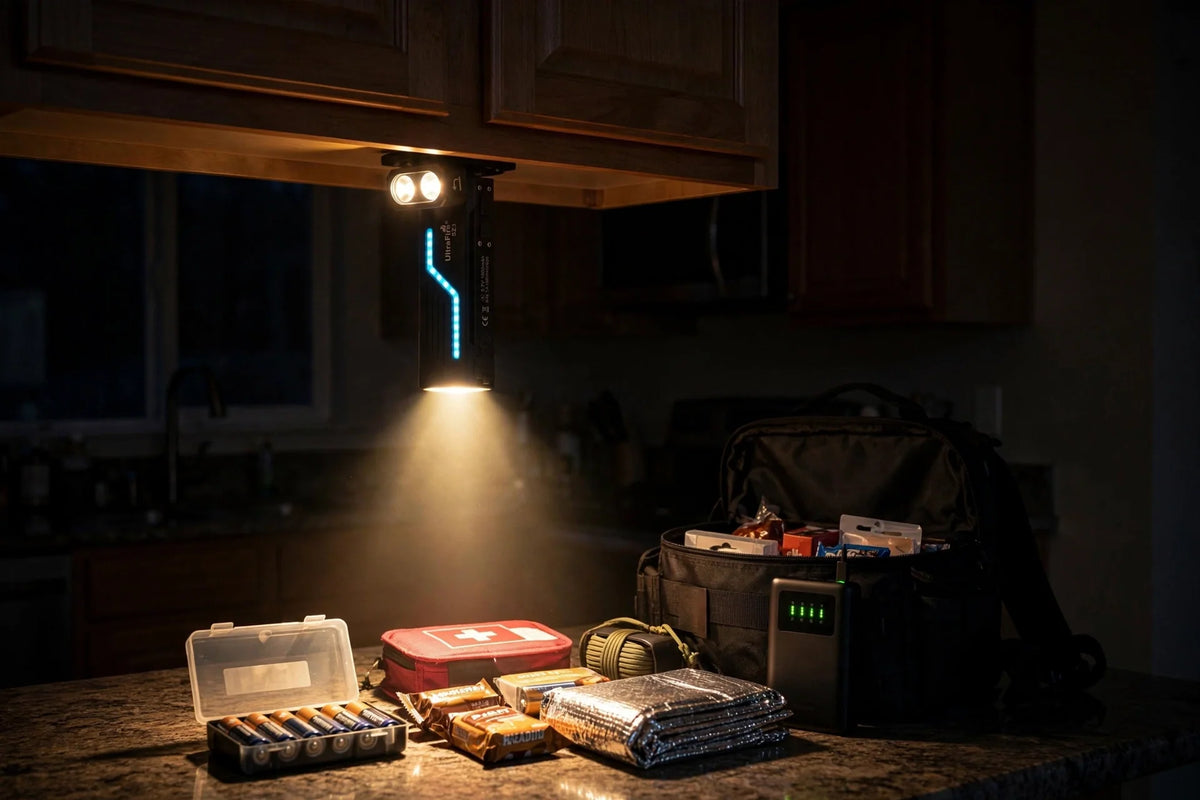
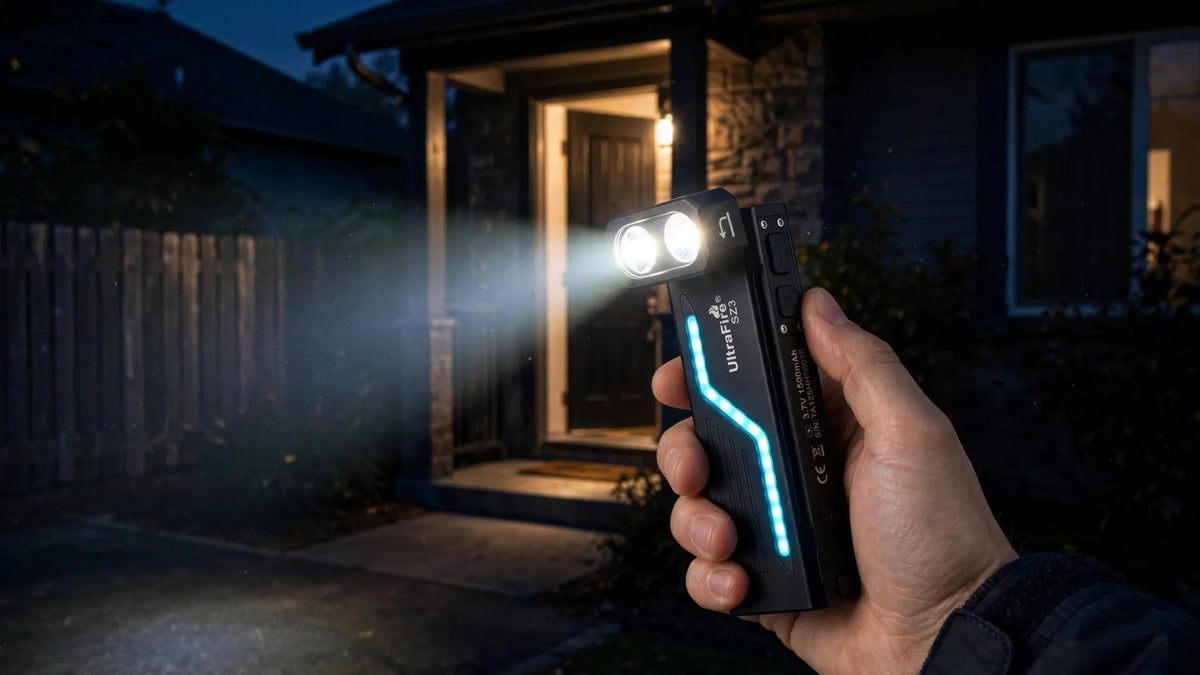
Storm outages mean work in the dark: checking the breaker box, finding the water shutoff, taping a rattling window, clearing the porch of debris. The SZ3's 0–100° swivel head and magnetic tail turn it into a hands-free work light — stick it to the fridge, a metal beam, or the car hood and aim the beam exactly where your hands are.

UltraFire SZ3 Swivel Head EDC Flashlight | 1300LM CRI90+
The storm-season workhorse: aim the swivel head at your task, stick the magnetic tail to anything metal, or bounce the flood beam off the ceiling to light a whole room when the power is out.
- 1,300 lumens, high-CRI 90+ for true colors
- 0–100° swivel head with spot + flood dual beams
- Magnetic tail for hands-free mounting
- 1,500 mAh battery, USB-C charging (works while charging on low)
- IPX6 waterproof, 1-meter drop resistance, 3-year warranty
Why it fits this storm: Wind-driven rain and night-time outages are exactly what IPX6 and a magnetic mount are for — the light keeps working in the wet, and both your hands stay free for the repair.
UltraFire UF-303X: Be Seen on Dark, Flooded Roads
Coastal flooding plus night driving is a dangerous combination. If you have to be near a road during the storm — evacuating, dealing with a breakdown, or marking a flooded street for neighbors — a signal light is far more visible to drivers than a bare flashlight beam. The UF-303X is a 2-in-1 tool: a dependable flashlight plus a detachable signal tube that turns it into a traffic wand.

UltraFire UF-303X Rechargeable Traffic Wand
One light, two jobs: a dependable flashlight for seeing, and a bright signal wand for roadside visibility, marking hazards, or directing around flooded streets.
- 2-in-1 design: flashlight + detachable signal tube
- USB-C rechargeable — no spare batteries to hunt for
- IPX6 waterproof for storm conditions
Why it fits this storm: Keep it in the car now, before Sunday afternoon. Flooded roads and dark shoulders are where a wand-style signal light earns its keep.
SZ3 vs. UF-303X: Which One Goes Where?
| Feature | SZ3 | UF-303X |
|---|---|---|
| Brightness | 1,300 lumens | Flashlight + signal wand |
| Standout feature | 0–100° swivel head, magnetic tail | Detachable signal tube (2-in-1) |
| Charging | USB-C (works while charging on low) | USB-C |
| Water resistance | IPX6 | IPX6 |
| Stash it | By the breaker panel / kitchen | In the car, by the door |
| Best for | Hands-free repairs, indoor area light | Roadside visibility, signaling |
Choose the SZ3 if you want one light that covers most indoor outage jobs.
Choose the UF-303X if you might be near roads at night during the storm.
For a nor'easter, most households want both: an SZ3 inside the house and a UF-303X in the car. Browse the full lineup in the UltraFire collection.
The Nor'easter Outage Checklist
- Primary flashlight (SZ3) charged, plus a signaling light (UF-303X) staged in the car
- Power bank fully charged + USB-C cables (charge the power bank first)
- Move patio furniture, planters, and anything the wind can pick up
- Secure trash bins — 60 mph gusts turn them into projectiles
- Charge phones and keep one on low-power mode during the outage
- Battery-powered or hand-crank radio for weather updates
- Water (one gallon per person per day), non-perishable food, medications
- First aid kit, blankets, and warm layers
- Cash — card readers don't work without power
- A written list of emergency contacts (phones die too)
- Fill the car with gas — pumps stop when the power does
If You Lose Power Sunday Night
Report the outage to your utility right away — crews prioritize by reports, not assumptions. Keep the fridge closed (food stays safe about 4 hours unopened), and use one light per room on low mode rather than blasting one room on turbo. Small discipline like that stretches a 1,500 mAh battery across a multi-day outage.
- Never drive through floodwater. Six inches of moving water can knock you down; twelve inches can carry a car. Turn around.
- Generators go outside. Never run a generator indoors or in a garage — carbon monoxide kills quietly.
- Treat every downed line as live. Stay at least 30 feet away and call your utility.
- Don't look into beams. High-lumen lights can damage eyes; never shine them at people or drivers.
- Unplug sensitive electronics. Surges when power returns can fry them.
- Check on neighbors. Elderly neighbors and anyone with medical devices need power first.
Final Thoughts
This storm arrives fast and peaks at night — exactly the combination that turns a wind event into a miserable outage. Fifteen minutes of prep today buys you a calm Sunday evening: lights charged, lights placed, and one bright wand in the car just in case.
Get storm-ready: the SZ3 for hands-free work indoors, and the UF-303X for visibility on dark roads.