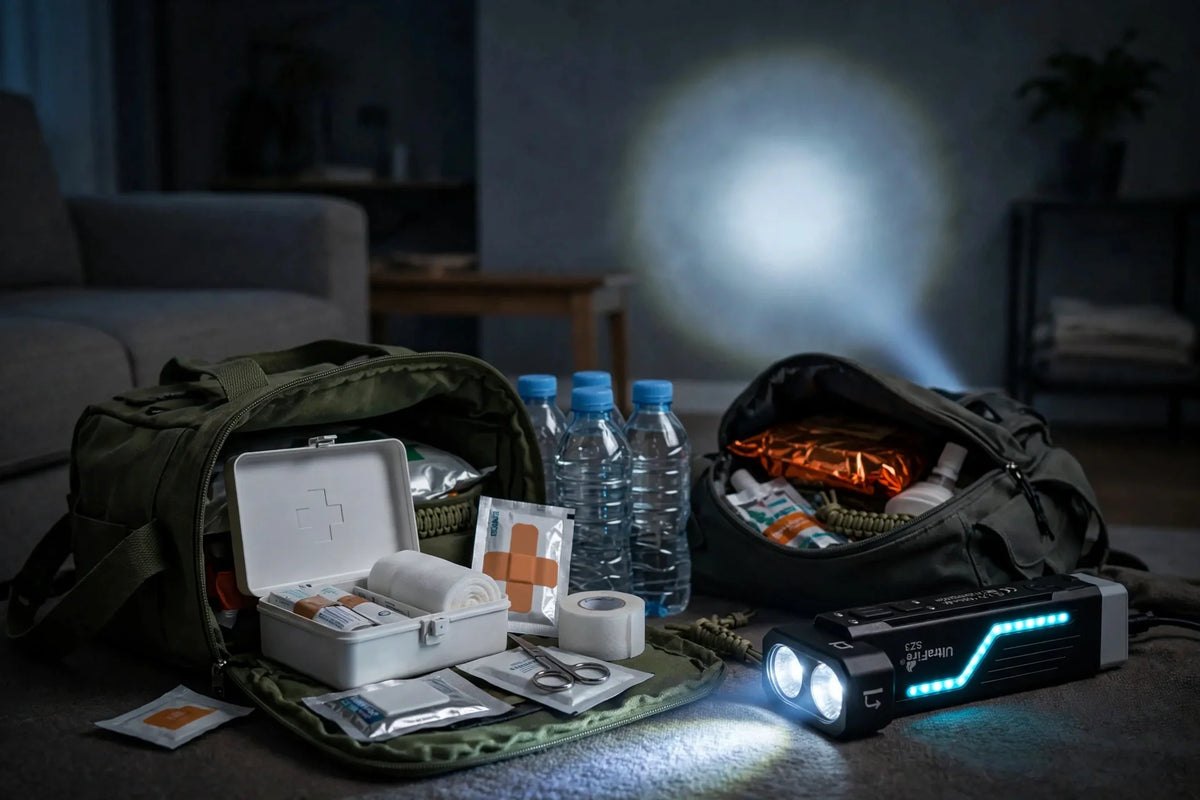

On Sunday, November 1, clocks across the US fall back an hour as daylight saving time ends. You gain an hour of sleep — and lose an hour of evening light. Suddenly the 5-to-7 PM window — the commute home, school pickup, the dog walk, the evening run — happens in the dark. This guide is about the simplest upgrade you can make before the time change: a light that helps you see and be seen.
- Daylight saving time ends Sunday, November 1, 2026 — sunsets arrive an hour earlier by the clock.
- Darker evenings mean lower visibility for commuters, kids walking home, dog walkers, and cyclists.
- A good after-dark light does two jobs: a bright beam so you can see, and a visible glow so drivers can see you.
- UltraFire SZ3: 1,300-lumen swivel-head EDC light with magnetic tail and a cyan ambient light bar for 360° visibility.
- UltraFire UF-303X: 2-in-1 flashlight + detachable signal tube — a traffic wand for roadside visibility.
Why November 1 Changes Your Evenings
The time change doesn't just affect sleep. It shifts darkness into the busiest hours of the day. After the fall-back:
- Evening commutes go dark. Leaving work at 5 or 6 PM soon means driving — or walking to the car — in low light.
- Kids get home in dusk. School pickup, after-school practice, and the walk home all slide into darker hours.
- Evening routines move into the dark. The dog walk, the jog, the trip to the mailbox — all suddenly need a light.
- Drivers see less. Pedestrians and cyclists in dark clothing blend into the road at dusk, the hardest visibility window of all.
Fire departments have long used the time change as a reminder — "change your clocks, change your batteries." This year, make it a reminder to check the lights you actually carry: are they charged, do they still work, and do you have one on you when the sun goes down?
See and Be Seen: The Two Jobs of One Light
Most people buy a flashlight to see in the dark. But once you're outside in it, the second job matters just as much: being seen. A beam pointed at the ground helps your eyes. A glow that surrounds you helps everyone else's.
- Reflective gear helps, but it needs light to reflect. A reflective strip is passive — it only works when a car's headlights already hit it.
- An active light works from every angle. A wand, an ambient glow, or a flashing marker shows your position before headlights arrive.
- Hands-free beats handheld on a walk. Clipped to a backpack, jacket, or leash, a light keeps glowing while your hands stay free for the dog, the keys, or your phone.
- Carry it, don't stash it. The best visibility light is the one on your body — a pocket-size EDC light you actually bring beats a big flashlight left at home.
UltraFire SZ3: The Pocket Light That Keeps You Visible
The SZ3 is a flat, pocket-size EDC light built for exactly this kind of evening. Clip it to a backpack strap or jacket, switch on the cyan ambient light bar, and you have a soft 360° glow that marks your position to drivers — while the 1,300-lumen main beam with a 0–100° swivel head handles seeing the path ahead.

UltraFire SZ3 Swivel Head EDC Flashlight | 1300LM CRI90+
Your everyday pocket light for darker evenings: clip it on for the walk, aim the swivel head at the path, and let the ambient bar keep you visible.
- 1,300 lumens, high-CRI 90+ for true colors
- 0–100° swivel head with spot + flood dual beams
- Side ambient light bar — a visible glow for drivers and passersby
- Magnetic tail for hands-free mounting on rails, posts, and car doors
- 1,500 mAh battery, USB-C charging (works while charging on low)
- IPX6 waterproof, 1-meter drop resistance, 3-year warranty
Why it fits fall-back evenings: It's small enough to carry every day, bright enough for unlit paths, and the ambient bar solves the "be seen" half of the equation that a normal beam misses.
UltraFire UF-303X: Be Seen From a Distance
For roadside situations — walking along a road with no sidewalk, changing a tire at dusk, directing cars at a school pickup line — a bare beam isn't enough. The UF-303X is a 2-in-1 tool: a regular flashlight plus a detachable signal tube that turns it into a traffic wand. Wand light is designed for exactly one thing: being unmistakably visible from a distance.

UltraFire UF-303X Rechargeable Traffic Wand
One light, two jobs: a dependable flashlight for seeing, and a bright signal wand for being seen on dark roads and in parking lots.
- 2-in-1 design: flashlight + detachable signal tube
- Signal-wand mode for roadside and parking-lot visibility
- USB-C rechargeable — no spare batteries to hunt for
- IPX6 waterproof for wet fall weather
Why it fits fall-back evenings: Keep it in the car. When you're on foot near traffic after dark — a roadside stop, a dark parking lot, a school zone — a wand-style signal is far more visible to drivers than a bare flashlight beam.
SZ3 vs. UF-303X: Which One Is Right for You?
| Feature | SZ3 | UF-303X |
|---|---|---|
| Brightness | 1,300 lumens | Flashlight + signal wand |
| Standout feature | 0–100° swivel head, magnetic tail, ambient light bar | Detachable signal tube (2-in-1) |
| Charging | USB-C (works while charging on low) | USB-C |
| Water resistance | IPX6 | IPX6 |
| Carry style | Pocket-size EDC, clip anywhere | Car, garage, entryway |
| Best for | Daily carry: walks, commutes, runs after dark | Roadside visibility, parking lots, signaling drivers |
Choose the SZ3 if you want one light on your body every evening — walks, commutes, and the school pickup run.
Choose the UF-303X if you spend time near traffic after dark and want to be seen from far away.
Many households end up with both: the SZ3 in the pocket, the UF-303X in the car. Browse the full lineup in the UltraFire collection.
Your Fall-Back Visibility Checklist
- Charge your EDC light now. Don't wait for November 1 — top off batteries and USB-C lights this weekend.
- Put a light on your body for evening walks. Clipped to a bag, jacket, or leash — not at the bottom of a drawer.
- Keep a signal light in the car. A wand-style light for roadside stops and dark parking lots.
- Add reflective elements to kids' gear. Reflective strips on backpacks and jackets, plus a small light they can clip on.
- Check the walk route lighting. Walk it once after dark and note the unlit stretches — that's where you need a beam.
- Test smoke and CO alarms. The time change is the classic reminder — batteries and test buttons, every November.
- Drivers: headlights on earlier. Dusk is the hardest visibility window; being seen is a two-way street.
- Walk facing traffic where there is no sidewalk, and keep to well-lit paths when you can.
- Don't look into beams. High-lumen lights can damage eyes; never aim them at people or oncoming drivers.
- Watch for kids near roads. School zones and neighborhoods get darker earlier — slow down at dusk.
- Keep your phone charged so your light and your communication don't die at the same time.
- Tell someone your route if you walk or run alone after dark.
Final Thoughts
November 1 is less than three weeks away. The hour you gain in sleep, you lose in evening light — and the simplest way to get it back is a light you actually carry. Charge it this weekend, clip it on your bag, and the fall-back will feel like nothing at all.
Ready for darker evenings? Carry the SZ3 on your evening walks, and keep a UF-303X in the car for the roadside.