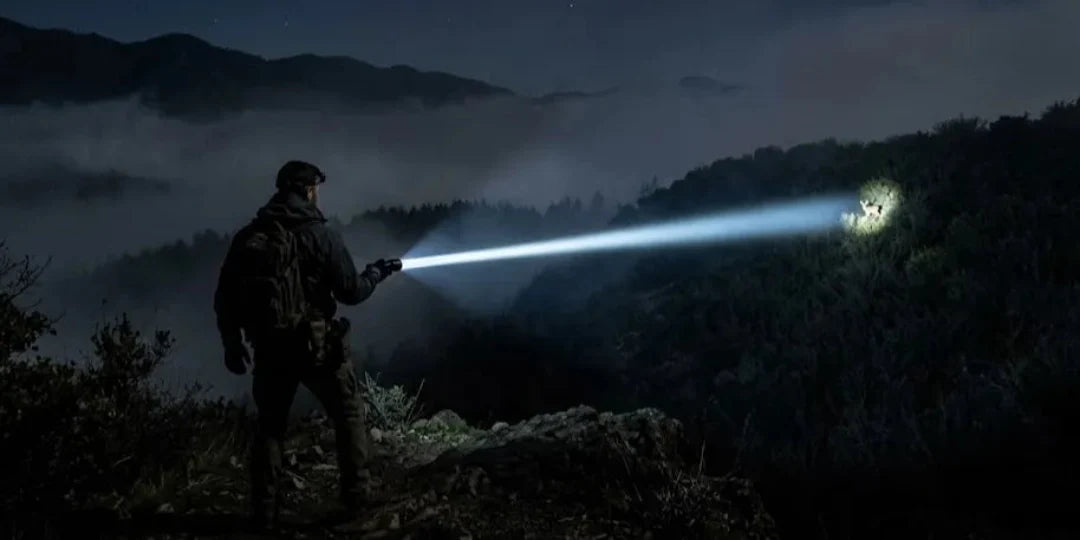

The Atlantic hurricane season runs through November 30, and October storms have a habit of arriving just as the days get shorter. When the power goes out, a flashlight stops being a gadget and becomes the most important tool in the house. This guide covers what actually matters in an emergency flashlight — brightness you can work by, runtime that lasts, charging you can manage without wall power — and how three UltraFire lights cover different jobs when the lights go out.
- Hurricane season runs June 1–November 30, and fall outages often last longer with shorter days.
- A good emergency flashlight needs usable brightness, long runtime, USB-C charging, water resistance, and a way to signal.
- UltraFire SZ3: 1,300-lumen swivel-head EDC light — hands-free work light for repairs and indoor tasks.
- UltraFire UF-303X: 2-in-1 signal wand — flashlight plus detachable traffic wand for roadside visibility.
- UltraFire A100: 1,000-lumen traffic wand — simple, bright, budget-friendly backup to stash everywhere.
Why Fall Storms Hit Different
Summer outages are inconvenient. Fall outages are darker, colder, and often longer.
- Shorter days. After daylight saving time ends on November 1, sunset comes an hour earlier. More of your evening happens in the dark.
- Longer outages. Fall storms can knock out power for days, not hours, especially in coastal and wooded areas.
- Colder nights. Without heat, you need light to check the breaker panel, find blankets, and move safely around the house.
- Road hazards. Downed branches and flooded streets make a signaling light as important as a seeing light.
What Makes a Good Emergency Flashlight
Not every bright light is a good emergency light. Here is what to look for:
- Usable brightness, not just turbo. You need a strong beam for outside and a lower mode for hours of indoor use without blinding everyone.
- Long runtime. An outage can last days. Efficient modes and a decent battery matter more than a 30-second turbo number.
- Easy charging. USB-C charging from a power bank or car means you are not hunting for disposable batteries mid-storm.
- Water resistance. Storms mean rain. IPX6 or better keeps the light working when conditions are wet.
- Signaling ability. A red or wand-style signal mode helps you stay visible to drivers and rescuers.
- Findability. Keep lights where you can grab them in the dark — a drawer by the bed, the kitchen counter, the car.
UltraFire SZ3: Hands-Free Light for Getting Things Done
When the power is out, most of what you need light for is work: checking the breaker box, finding the water shutoff, patching a window, or just moving around the house. The SZ3's 0–100° swivel head and magnetic tail turn it into a hands-free work light — stick it to the fridge or a metal beam and aim it where you need it.

UltraFire SZ3 Swivel Head EDC Flashlight | 1300LM CRI90+
The do-everything light for outage life: aim the swivel head at your work, stick the magnetic tail to anything metal, or bounce the flood beam off the ceiling to light a whole room.
- 1,300 lumens, high-CRI 90+ for true colors
- 0–100° swivel head with spot + flood dual beams
- Magnetic tail for hands-free mounting
- 1,500 mAh battery, USB-C charging (works while charging on low)
- IPX6 waterproof, 1-meter drop resistance, 3-year warranty
Why it fits emergencies: The flood beam lights a room without harsh glare, the magnet frees both hands for repairs, and USB-C means a power bank keeps it going for days.
UltraFire UF-303X: Be Seen When It Matters
Seeing is only half the job in an emergency. The other half is being seen — by drivers on a dark road, by neighbors, by anyone who needs to find you. The UF-303X is a 2-in-1 tool: a regular flashlight plus a detachable signal tube that turns it into a traffic wand.

UltraFire UF-303X Rechargeable Traffic Wand
One light, two jobs: a dependable flashlight for seeing, and a bright signal wand for directing traffic, marking hazards, or making yourself visible on a dark roadside.
- 2-in-1 design: flashlight + detachable signal tube
- USB-C rechargeable — no spare batteries to hunt for
- IPX6 waterproof for storm conditions
Why it fits emergencies: If you have to drive during an outage or deal with a roadside breakdown in the dark, a wand-style signal light is far more visible to other drivers than a bare flashlight beam.
UltraFire A100: The Simple Bright Backup
The best emergency light is the one you actually have nearby. At a budget-friendly price, the A100 is the light you stash everywhere: one in the car, one in the kitchen drawer, one by the bed. A full 1,000 lumens in a simple traffic-wand body — no learning curve when the lights go out.

UltraFire A100 Traffic Wand | 1000 Lumens
Bright, simple, and ready to go. Keep one everywhere you might need light in a hurry.
- 1,000 lumens output
- Traffic wand body for visibility
- Simple operation — no modes to memorize in the dark
SZ3 vs. UF-303X vs. A100: Which One Is Right for You?
| Feature | SZ3 | UF-303X | A100 |
|---|---|---|---|
| Brightness | 1,300 lumens | Signal wand + flashlight | 1,000 lumens |
| Standout feature | 0–100° swivel head, magnetic tail | Detachable signal tube (2-in-1) | Simple, budget-friendly |
| Charging | USB-C | USB-C | — |
| Water resistance | IPX6 | IPX6 | — |
| Best for | Hands-free repairs, indoor area light | Roadside visibility, signaling | Stash-everywhere backup |
Choose the SZ3 if you want one light that does the most jobs around the house during an outage.
Choose the UF-303X if roadside visibility and signaling matter to you — drivers, parking crews, or anyone working near traffic.
Choose the A100 if you want bright, simple backups in every room and the car without overthinking it.
Many households end up with a mix: an SZ3 for work, a UF-303X for the car, and A100s wherever a drawer exists. Browse the full lineup in the UltraFire collection.
Your Power Outage Kit Checklist
- Primary flashlight (SZ3 or similar) + a signaling light (UF-303X) for the car
- Backup lights stashed where you can find them in the dark (A100s in drawers)
- Power bank + USB-C cables, charged before storm season
- Spare charged batteries for lights that use them
- Battery-powered or hand-crank radio for weather updates
- Water (one gallon per person per day), non-perishable food, medications
- First aid kit, blankets, and warm layers
- Cash — card readers don't work without power
- A written list of emergency contacts (phones die too)
Keep Everything Charged Before Storm Season
Lithium-ion batteries slowly self-discharge. Top off your flashlights and power banks at the start of hurricane season and again before any named storm approaches. Store lights where you can grab them without light — muscle memory beats a perfect system.
- Generators go outside. Never run a generator indoors or in a garage — carbon monoxide kills quietly.
- Don't look into beams. High-lumen lights can damage eyes; never shine them at people or drivers.
- Unplug sensitive electronics. Surges when power returns can fry them.
- Check on neighbors. Elderly neighbors and anyone with medical devices need power first.
- Keep fridge closed. An unopened fridge keeps food safe for about 4 hours.
- Report outages, don't assume. Call your utility — they prioritize by reports.
Final Thoughts
Hurricane season doesn't end when summer does, and this year's fall storms arrive with shorter days and longer nights. A little preparation now — the right lights, charged and where you can find them — turns a multi-day outage from a crisis into an inconvenience.
Ready to build your kit? Start with the SZ3 for work, add a UF-303X for the car, and stash A100s everywhere else.